
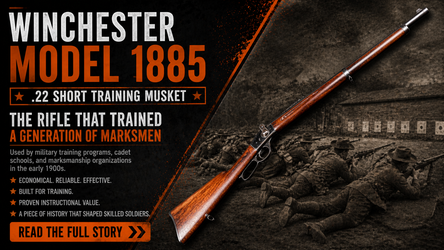
Winchester Model 1885 .22 Short Training Musket: The Rifle That Trained a Generation of Marksmen
Posted by Quick Draw Gun on May 1st 2026
The Winchester Model 1885 .22 Short Training Musket is a fascinating and often overlooked piece of military history. While it was never a frontline combat rifle, it played a critical role behind the scenes—training soldiers in marksmanship during a time when accuracy and discipline were essential on the battlefield.
Built on one of the strongest single-shot actions ever designed, the Model 1885 became an ideal platform for economical and effective training.
Origins of the Winchester Model 1885
The Winchester Model 1885 was originally designed by the legendary firearms inventor John Moses Browning. Introduced in the late 19th century, it quickly gained a reputation for:
- Exceptional strength
- Outstanding accuracy
- Simple, reliable operation
The rifle used a single-shot falling block action, which made it one of the strongest designs of its time.
While originally chambered in a variety of calibers for hunting and target shooting, the platform would later be adapted for training purposes.
Why the Military Needed Training Muskets
In the early 20th century, military forces began to recognize the importance of structured marksmanship training.
However, training with full-power service rifles presented several challenges:
- High ammunition costs
- Increased recoil for new shooters
- Limited access to large training ranges
To solve this, militaries began adopting small-caliber training rifles, often chambered in .22 Short or .22 Long Rifle.
These rifles allowed soldiers to:
- Practice fundamentals at reduced cost
- Train in smaller indoor or short-range environments
- Develop accuracy without heavy recoil
The Winchester M1885 as a Training Rifle
Winchester adapted the Model 1885 into a training musket configuration, chambered in .22 Short.
This version was designed to replicate the look and feel of full-size service rifles while offering the benefits of rimfire ammunition.
Key characteristics included:
- Full-length stock similar to military rifles
- Extended barrel for improved sight radius
- Military-style sights for training consistency
The result was a rifle that closely mimicked service weapons while being far more practical for training use.
Military Use of the .22 Short Training Musket
The Winchester M1885 .22 Short Training Musket saw use primarily in:
- Military training programs
- Cadet and preparatory schools
- Marksmanship training organizations
These rifles were especially valuable in pre-WWI and interwar periods, when marksmanship training became more formalized.
Marksmanship Training
The primary role of the rifle was to teach:
- Sight alignment
- Trigger control
- Breathing techniques
- Shooting discipline
Because the .22 Short cartridge produces minimal recoil and noise, it allowed trainees to focus on fundamentals without distraction.
Indoor and Short-Range Training
One of the biggest advantages of the .22 Short was its suitability for indoor ranges.
This allowed training to continue:
- Year-round
- In urban environments
- Without the need for large outdoor ranges
This was a major step forward in making marksmanship training more accessible.
Advantages of the .22 Short Platform
The use of .22 Short ammunition offered several benefits:
Cost Efficiency
Rimfire ammunition was significantly cheaper than full-power military cartridges, allowing for more training with less expense.
Reduced Recoil
New shooters could develop proper technique without being affected by heavy recoil.
Increased Repetition
Lower cost and recoil meant soldiers could practice more frequently, improving overall proficiency.
Comparison to Other Training Rifles
The Winchester M1885 training musket was part of a broader trend in military training rifles.
Other examples included:
- Springfield .22 training rifles
- British .22 conversion rifles
- European cadet training rifles
Compared to these, the M1885 stood out for its:
- Strong and durable action
- Excellent accuracy
- High-quality craftsmanship
Decline and Legacy
As military firearms evolved into semi-automatic and automatic platforms, single-shot training rifles like the M1885 became less common.
However, their influence remained.
Modern training methods still rely on the same principles:
- Start with fundamentals
- Use low-recoil platforms for instruction
- Build accuracy through repetition
The Winchester M1885 training musket helped establish these practices.
Collectibility Today
Today, the Winchester M1885 .22 Short Training Musket is a sought-after collectible.
Collectors value these rifles for:
- Their connection to military training history
- Their association with John Moses Browning
- Their craftsmanship and durability
Well-preserved examples, especially those with military or training provenance, are particularly desirable.
Why This Rifle Still Matters
The Winchester M1885 training musket represents a critical shift in how militaries approached training.
It demonstrated that:
- Effective training does not require full-power weapons
- Fundamentals are the foundation of marksmanship
- Simplicity and consistency can produce better shooters
These lessons are still applied today in both military and civilian training environments.
Final Thoughts
The Winchester Model 1885 .22 Short Training Musket may not have seen combat, but its impact on military readiness and marksmanship training is undeniable.
By providing a practical, accurate, and affordable training tool, it helped shape generations of skilled shooters.
For collectors and historians, it stands as a reminder that sometimes the most important firearms are not those used in battle—but those used to prepare for it.
Explore Historic Firearms at Quick Draw Gun
At QuickDrawGun.com, we appreciate the history behind the firearms we carry. From classic training rifles to modern platforms, our inventory reflects the evolution of firearms through time.