
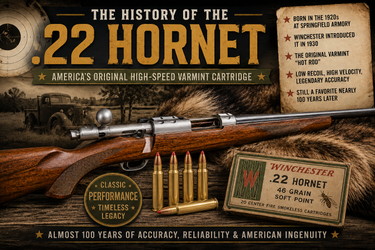
The History of the .22 Hornet: America's Original High-Speed Varmint Cartridge
Posted by Quick Draw Gun on Jul 7th 2026
For nearly a century, the .22 Hornet has earned a reputation as one of the most enjoyable and effective small-caliber cartridges ever developed. Long before the arrival of cartridges like the .223 Remington, .22-250, or .204 Ruger, the .22 Hornet was setting the standard for high-velocity performance, impressive accuracy, and low recoil.
Today, the .22 Hornet remains a favorite among collectors, varmint hunters, and shooters who appreciate classic firearms and timeless cartridge design.
Born From Military Brass
The story of the .22 Hornet begins during the 1920s at the historic Springfield Armory. Firearms experimenters sought to create a small-caliber, high-velocity cartridge capable of outperforming the rimfire cartridges of the day while remaining economical to shoot.
Using the .22 WCF (Winchester Center Fire) case as the foundation, several talented gunsmiths and ballisticians—including Townsend Whelen, G.L. Wotkyns, and Colonel Grosvenor Wotkyns—worked to improve the design. They strengthened the brass, modernized the chamber dimensions, and paired it with smokeless powder to achieve velocities previously unheard of in a commercial .22-caliber cartridge.
The result was the cartridge that would become known as the .22 Hornet.
Winchester Brings It to the Public
Recognizing its potential, Winchester officially introduced the .22 Hornet in 1930, chambering it in the legendary Model 54 bolt-action rifle.
At a time when most .22 Long Rifle ammunition produced around 1,100 feet per second, the .22 Hornet was capable of launching a 45-grain bullet at approximately 2,600 feet per second—more than doubling the effective range while dramatically increasing terminal performance.
Hunters immediately embraced the cartridge for:
- Coyotes
- Foxes
- Groundhogs
- Prairie Dogs
- Woodchucks
- Crows
- Small predators
- Farm pest control
The .22 Hornet quickly became America's first truly successful commercial varmint cartridge.
The Original "Hot Rod"
During the 1930s and 1940s, there simply wasn't anything else like it.
The .22 Hornet offered:
- Flat trajectory
- Minimal recoil
- Excellent accuracy
- Low powder consumption
- Mild report compared to larger centerfire cartridges
For many hunters, it became the perfect rifle to carry all day across farms, ranches, and open prairie.
Because the cartridge uses relatively little powder, shooters could spend an entire afternoon shooting varmints without the expense associated with larger calibers.
Ruger Helps Keep the Hornet Alive
Although newer cartridges eventually arrived—including the .222 Remington, .223 Remington, and .22-250 Remington—the .22 Hornet never disappeared.
Manufacturers like Ruger helped keep the cartridge relevant by chambering it in rifles such as:
- Ruger No. 1
- Ruger 77/22 Hornet
- Ruger M77
- Ruger American (limited production)
The Ruger 77/22 Hornet became especially popular thanks to its controlled-round-feed action, rotary magazine, and exceptional craftsmanship.
Even today, many hunters consider it one of the finest factory rifles ever produced for the cartridge.
Why Shooters Still Love the .22 Hornet
Despite being nearly 100 years old, the .22 Hornet still offers several advantages over modern cartridges.
Low Recoil
The .22 Hornet produces virtually no felt recoil, making it enjoyable for beginners and experienced shooters alike.
Quiet Performance
Compared to larger centerfire cartridges, the .22 Hornet has a noticeably softer report, making it well suited for rural properties and controlled hunting environments.
Efficient Powder Usage
Typical loads use only 10–14 grains of powder, allowing handloaders to produce large quantities of ammunition economically.
Outstanding Accuracy
Quality rifles regularly produce excellent accuracy, particularly with carefully developed handloads.
Minimal Barrel Wear
The moderate velocity and powder charge contribute to exceptional barrel life.
Handloaders' Favorite
One reason the .22 Hornet has remained popular is its flexibility for reloaders.
Bullet weights commonly range from:
- 35 Grain
- 40 Grain
- 45 Grain
- 46 Grain
- 50 Grain
Modern powders have allowed shooters to safely improve consistency while maintaining the cartridge's legendary efficiency.
Many experienced reloaders consider the .22 Hornet one of the most satisfying cartridges to develop loads for.
Collectibility
Collectors appreciate .22 Hornet rifles because many were produced in relatively limited numbers.
Popular collectible models include:
- Winchester Model 54
- Winchester Model 70
- Ruger 77/22 Hornet
- Ruger No. 1
- Anschütz Sporters
- CZ 527 American
- Savage Model 23D
These rifles often command strong values due to their craftsmanship and enduring appeal.
Is the .22 Hornet Still Relevant?
Absolutely.
While the .223 Remington has become the dominant modern varmint cartridge, the .22 Hornet continues to offer advantages that many shooters appreciate:
- Less muzzle blast
- Less recoil
- Lower powder consumption
- Classic rifle designs
- Excellent performance on small game and varmints
For hunters who don't need extreme long-range capability, the .22 Hornet remains an incredibly practical and enjoyable choice.
A Cartridge That Refuses to Fade Away
Few cartridges have enjoyed the longevity of the .22 Hornet. Introduced during the Great Depression and still in production nearly a century later, it has proven that smart design never goes out of style.
Whether carried in a classic Winchester, a beautifully crafted Ruger 77/22, or another favorite bolt-action rifle, the .22 Hornet continues to deliver the same qualities that made it famous nearly 100 years ago—accuracy, efficiency, and pure shooting enjoyment.
At Quick Draw Gun, we're proud to offer classic chamberings like the .22 Hornet for shooters who appreciate firearm history as much as field performance. If you've never experienced the charm of this iconic cartridge, there's never been a better time to discover why it has remained an American favorite for generations.