
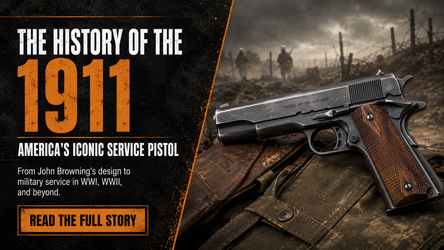
The History of the 1911: America’s Most Iconic Semi-Automatic Pistol
May 20th 2026
Few firearms have earned the legendary status of the 1911 pistol. Designed by John Moses Browning and adopted by the U.S. military in 1911, this semi-automatic handgun became one of the most respected sidearms in American history.
From the battlefields of World War I and World War II to modern concealed carry, competition shooting, and collecting, the 1911 has remained relevant for more than a century. Its combination of power, reliability, craftsmanship, and timeless design has made it one of the most recognizable pistols ever produced.
Origins of the 1911 Pistol
The story of the 1911 begins in the early 1900s, when the U.S. military was searching for a more effective sidearm. Earlier service revolvers had shown limitations, especially during close-range combat where greater stopping power was desired.
The U.S. Army wanted a semi-automatic pistol chambered in a larger caliber. John Moses Browning, already one of the most important firearm designers in history, developed a rugged recoil-operated pistol chambered in .45 ACP.
After extensive testing, Browning’s design proved exceptionally durable and reliable. In 1911, it was officially adopted as the Model of 1911 U.S. Army pistol, giving birth to one of the most famous handguns in the world.
John Moses Browning and the Birth of a Legend
John Browning’s genius was in designing firearms that were both innovative and practical. The 1911 used a short-recoil operating system that became a foundation for countless modern handguns.
The pistol featured:
A single-action trigger
A grip safety
A manual thumb safety
A seven-round detachable magazine
A strong steel frame and slide
The powerful .45 ACP cartridge
The design was simple enough for military use, strong enough for combat, and accurate enough to earn the confidence of generations of shooters.
The 1911 in World War I
The 1911 saw its first major combat use during World War I.
American soldiers carried the pistol in the trenches of Europe, where close-quarters fighting demanded a dependable sidearm. The .45 ACP cartridge offered strong stopping power, and the pistol’s rugged construction made it suitable for harsh battlefield conditions.
By the end of World War I, the 1911 had proven itself as a reliable military handgun. Its reputation for toughness and effectiveness was firmly established.
The 1911A1 Update
In 1924, the original 1911 design was updated into what became known as the M1911A1.
The changes were not drastic, but they improved handling and comfort. Updates included:
A shorter trigger
An arched mainspring housing
Improved grip safety tang
Relief cuts behind the trigger
Improved sights
Revised grip design
The M1911A1 retained the same basic operating system and .45 ACP chambering, but it became slightly more comfortable and easier to shoot for a wider range of soldiers.
The 1911 in World War II
World War II cemented the 1911’s place in American military history.
During the war, millions of 1911A1 pistols were produced by several manufacturers to meet military demand. While Colt was the original manufacturer, wartime production also included companies such as:
Remington Rand
Ithaca Gun Company
Union Switch & Signal
Singer Manufacturing Company
The pistol served across every theater of the war, from Europe to the Pacific. It was carried by officers, tank crews, pilots, military police, special units, and many other service members.
Its reliability, stopping power, and rugged build made it one of the most trusted sidearms of the conflict.
Military Service After WWII
After World War II, the 1911 continued serving the U.S. military through Korea, Vietnam, and the Cold War era.
For decades, it remained the standard American service pistol. Even after the U.S. military officially replaced it with the Beretta M9 in the 1980s, the 1911 never truly disappeared.
Specialized military units, competitive shooters, law enforcement officers, and civilian defenders continued to value the platform for its accuracy, trigger quality, and proven performance.
Why the 1911 Became So Popular
The 1911’s popularity comes from more than nostalgia. It offers several qualities that continue to attract shooters today.
Excellent Trigger
The 1911’s single-action trigger is one of the reasons it remains popular with serious shooters. A well-tuned 1911 trigger can be crisp, clean, and predictable, making it excellent for accuracy.
Natural Ergonomics
Many shooters find the 1911 grip angle comfortable and intuitive. The slim frame, especially in single-stack models, gives it a natural feel in the hand.
Powerful .45 ACP Chambering
The classic 1911 is closely associated with .45 ACP, a cartridge respected for its heavy bullet and manageable recoil impulse.
Timeless Steel Construction
Traditional 1911 pistols are built from steel, giving them a solid feel and helping manage recoil.
Customization Potential
The 1911 is one of the most customizable handgun platforms ever made. Shooters can modify sights, triggers, grips, safeties, barrels, finishes, and internal components.
The 1911 in Competition Shooting
The 1911 became a major force in competitive shooting.
Its accuracy, trigger quality, and customization potential made it a favorite in bullseye shooting, practical shooting, and action pistol sports. Many modern competition pistols still trace their roots to the 1911 design.
The platform also evolved into double-stack variants, commonly associated with competition use, offering higher capacity while maintaining the familiar 1911-style controls and trigger system.
The 1911 for Concealed Carry and Personal Defense
Although modern polymer-framed pistols dominate much of today’s concealed carry market, the 1911 remains a respected defensive handgun.
Compact and Commander-size 1911 models offer reduced size and weight compared to traditional full-size Government models. Many shooters still prefer the slim profile, manual safety system, and excellent trigger.
Common defensive 1911 chamberings include:
.45 ACP
9mm
10mm Auto
.38 Super
The 1911 may require more maintenance and training than some modern striker-fired pistols, but in skilled hands it remains a highly capable defensive firearm.
Popular 1911 Variations
Over the years, the 1911 has been produced in many sizes and configurations.
Government Model
The classic full-size 1911 with a 5-inch barrel. This is the traditional military-style configuration.
Commander Model
A slightly shorter version, often with a 4.25-inch barrel, designed for easier carry while maintaining good shootability.
Officer Model
A compact 1911 designed for concealed carry with a shorter grip and barrel.
Long Slide Models
Often used for hunting, competition, or target shooting, these models feature longer barrels and improved sight radius.
Modern Tactical 1911s
Updated 1911 pistols may include accessory rails, night sights, extended safeties, beavertail grip safeties, match barrels, and improved finishes.
Collectibility of Military 1911 Pistols
Original U.S. military 1911 and 1911A1 pistols are highly collectible.
Collectors often look for:
Original finish
Matching correct parts
Military markings
Manufacturer history
Wartime production dates
Documented provenance
WWI and WWII-era examples can command strong collector interest, especially rare manufacturers or pistols in excellent condition.
Singer-produced 1911A1 pistols are among the rarest and most valuable due to their extremely limited production.
The 1911’s Lasting Influence
The 1911 influenced handgun design for more than a century.
Many modern pistols borrow ideas from the 1911, including:
Short-recoil operation
Manual thumb safety concepts
Ergonomic grip design
Match-grade trigger expectations
Modular customization culture
Even though handgun technology has changed dramatically, the 1911 remains relevant because its core design still works exceptionally well.
1911 vs Modern Pistols
Compared to many modern polymer pistols, the 1911 usually offers:
A better trigger
A slimmer grip profile
Classic styling
Greater customization
Strong collector appeal
Modern pistols often offer:
Higher capacity
Lower weight
Simpler maintenance
Lower cost
Less sensitivity to tuning
Neither design is automatically better. The choice depends on the shooter’s needs, preferences, and experience level.
Why the 1911 Still Matters Today
The 1911 is more than a historic pistol. It is a symbol of American firearm design, military history, and mechanical excellence.
It served through major conflicts, influenced modern handguns, and remains one of the most respected pistol platforms in the world.
For collectors, it represents history.
For competitors, it represents precision.
For shooters, it represents a timeless design that still performs.
Final Thoughts
The 1911 pistol has earned its place as one of the most iconic firearms ever made. Designed by John Moses Browning and adopted by the U.S. military in 1911, it served through two World Wars, Korea, Vietnam, and beyond.
More than 100 years later, the 1911 remains popular among collectors, competitors, concealed carriers, and firearm enthusiasts.
Its lasting appeal comes from a rare combination of history, performance, craftsmanship, and unmistakable style.
The 1911 is not just a handgun. It is a piece of American history.
Explore 1911 Pistols at Quick Draw Gun
At QuickDrawGun.com, we carry a wide selection of classic, collectible, and modern handguns, including 1911-style pistols from trusted manufacturers.
Whether you are looking for a historic military-style 1911, a modern carry model, or a competition-ready pistol, the 1911 remains one of the most rewarding platforms to own.