
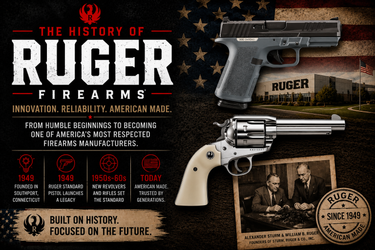
The History of Ruger Firearms: From a Small Startup to an American Firearms Icon
Posted by Quick Draw Gun on Jun 22nd 2026
Few names in the firearms industry carry the reputation and recognition of Sturm, Ruger & Co., Inc., commonly known simply as Ruger. Known for producing reliable, innovative, and affordable firearms, Ruger has become one of America's largest firearms manufacturers. From humble beginnings in a small machine shop to becoming a household name among hunters, sport shooters, and firearm enthusiasts, Ruger's story is a remarkable example of American ingenuity and entrepreneurship.
The Founding of Ruger
Ruger was founded in 1949 by William B. Ruger and Alexander McCormick Sturm in Southport, Connecticut. The company began with a shared vision of designing and manufacturing quality firearms that combined classic styling with modern manufacturing techniques.
William Ruger was an accomplished firearms designer with a passion for engineering and firearms history. His first major design, inspired by the Japanese Nambu pistol, became the foundation for the company's first product: the Ruger Standard Model .22 pistol.
To finance the venture, Sturm and Ruger invested approximately $50,000, a significant amount at the time. Their small operation quickly gained momentum as demand for the Standard Model pistol exceeded expectations.
The Ruger Standard Pistol Revolution
Released in 1949, the Ruger Standard pistol changed the landscape of rimfire handguns. The pistol offered shooters an affordable, reliable, and accurate .22 LR handgun at a time when quality firearms often came with a hefty price tag.
The pistol's sleek appearance, inspired by the German Luger and Japanese Nambu designs, immediately attracted attention. More importantly, Ruger utilized innovative investment casting methods that allowed the company to produce firearms efficiently while maintaining strength and durability.
The Standard Model became an instant success and laid the foundation for Ruger's future growth.
Growth Through Innovation
Throughout the 1950s and 1960s, Ruger expanded its product lineup dramatically.
Ruger Single-Six
Introduced in 1953, the Single-Six revolver capitalized on America's renewed fascination with the Old West. Chambered in .22 LR, the Single-Six offered the look and feel of a classic single-action revolver while maintaining Ruger's reputation for affordability and reliability.
Ruger Blackhawk
In 1955, Ruger introduced the Blackhawk, a centerfire single-action revolver designed to handle more powerful cartridges than traditional Colt-style revolvers. The Blackhawk quickly became a favorite among hunters and outdoorsmen.
Investment Casting Advantage
One of Ruger's greatest innovations was its extensive use of investment casting, a manufacturing process that allowed the company to produce strong firearm components more efficiently than traditional machining methods. This approach helped Ruger maintain competitive pricing while delivering robust firearms.
Expanding into Rifles
Ruger entered the rifle market in a major way during the 1960s.
Ruger 10/22
Introduced in 1964, the Ruger 10/22 became one of the most successful rimfire rifles ever produced. Featuring a detachable rotary magazine and exceptional reliability, the 10/22 quickly became a favorite among recreational shooters, hunters, and firearm enthusiasts.
Today, the 10/22 remains one of the most customizable rifles in the world, with countless aftermarket accessories and upgrades available.
Ruger M77
In 1968, Ruger launched the M77 bolt-action rifle, designed to compete with established hunting rifles from Winchester and Remington. The M77 featured controlled-round feed and a strong action, making it highly popular among hunters seeking a dependable field rifle.
Entering the Modern Era
During the 1980s and 1990s, Ruger expanded into semi-automatic pistols and modern sporting rifles.
P-Series Pistols
The Ruger P-Series offered durable, affordable semi-automatic handguns designed for law enforcement, military, and civilian shooters. These pistols established Ruger as a serious player in the defensive handgun market.
Mini-14
The Ruger Mini-14, introduced in 1973, became one of the company's most recognizable rifles. Chambered in .223 Remington/5.56 NATO, the rifle gained popularity among ranchers, law enforcement agencies, and civilian shooters due to its reliability and simple operation.
Leadership Changes and Continued Growth
Following the passing of Alexander Sturm in 1951 and William Ruger's retirement in 2000, the company continued to evolve under new leadership.
Ruger modernized its manufacturing facilities, expanded production capabilities, and focused heavily on innovation. New product introductions helped the company remain competitive in an increasingly crowded firearms market.
Ruger's Modern Success
In the 21st century, Ruger has introduced several highly successful firearm platforms:
Ruger LCP
The Lightweight Compact Pistol (LCP) helped redefine the concealed carry market. Its compact size and lightweight design made it one of the most popular pocket pistols ever produced.
Ruger American Rifle
Introduced in 2011, the Ruger American Rifle provided hunters with an affordable yet highly accurate bolt-action rifle. The platform quickly became one of the best-selling hunting rifles in America.
Ruger Precision Rifle
The Ruger Precision Rifle (RPR) brought long-range shooting performance to a broader audience. Offering excellent accuracy at a competitive price point, the RPR became a favorite among precision shooters.
Ruger PC Carbine
The PC Carbine combined versatility, reliability, and magazine compatibility, making it a popular choice for home defense, recreational shooting, and competition use.
Manufacturing Excellence
Today, Ruger operates major manufacturing facilities in:
- Newport, New Hampshire
- Prescott, Arizona
- Mayodan, North Carolina
The company continues to emphasize American manufacturing and quality control, with nearly all Ruger firearms proudly made in the United States.
Ruger's Impact on American Firearms
Few firearm manufacturers have had as much influence on the modern firearms industry as Ruger. The company's commitment to innovation, affordability, and reliability has introduced generations of Americans to shooting sports, hunting, and firearm ownership.
From the iconic 10/22 and Single-Six to modern favorites like the American Rifle and Precision Rifle, Ruger's products have earned a reputation for delivering exceptional value without sacrificing performance.
Conclusion
What began as a small startup founded by William Ruger and Alexander Sturm has grown into one of the most respected firearms manufacturers in the world. For more than 75 years, Ruger has remained dedicated to producing dependable firearms that meet the needs of hunters, competitors, collectors, and everyday shooters.
As Ruger continues to innovate and expand its product offerings, its legacy as an American firearms pioneer remains firmly intact. Whether you're carrying a Ruger handgun, hunting with a Ruger rifle, or introducing a new shooter to the sport with a 10/22, you're participating in a tradition that has helped shape the history of American firearms.