
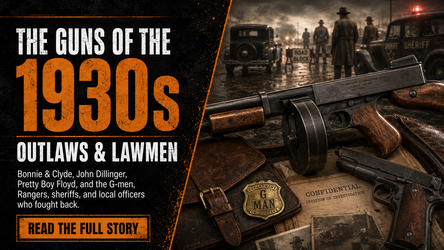
The Guns Used by Outlaws & Lawmen During the 1930s: 11 Months of Hell
Posted by Quick Draw Gun on May 26th 2026
The early 1930s produced one of the most violent and fascinating eras in American crime history. The Great Depression had crushed banks, farms, and small towns. At the same time, fast cars, paved roads, and powerful firearms gave criminals a new kind of mobility and firepower.
For roughly a year, America watched a deadly war unfold between notorious outlaws and the lawmen hunting them. Names like Bonnie and Clyde, John Dillinger, and Pretty Boy Floyd filled newspapers. On the other side were FBI “G-men,” Texas Rangers, county sheriffs, city police, state patrol officers, and local deputies trying to stop criminals who often outgunned them.
This was the era when the modern American manhunt was born.
Why the 1930s Became the Gangster Gun Era
By the early 1930s, criminals were no longer limited to horseback escapes or small-town hideouts. They used stolen cars, crossed state lines, hit banks and police arsenals, and used weapons that shocked the public.
The FBI describes John Dillinger’s gang as terrorizing the Midwest from September 1933 to July 1934, killing 10 men, wounding 7 others, robbing banks and police arsenals, and staging multiple jail breaks.
That short window of violence changed law enforcement forever.
Before this era, federal agents had limited authority. Local sheriffs and police departments carried much of the burden. But after events like the Kansas City Massacre, public pressure grew for stronger federal law enforcement. The FBI notes that the Kansas City Massacre involved the deaths of four peace officers and prisoner Frank Nash during an attempted rescue by criminals.
The Outlaws and Their Guns
Bonnie Parker & Clyde Barrow
Bonnie and Clyde remain two of the most famous criminals in American history. Their crime spree ran through the central United States during the Great Depression, with robberies, kidnappings, murders, stolen vehicles, and constant flight from law enforcement.
The FBI states that Bonnie Parker and Clyde Barrow were killed in an ambush near Sailes, Louisiana, on May 23, 1934, after one of the largest manhunts of the time.
Firearms Associated with Bonnie and Clyde
The Barrow Gang was known for heavy firepower. Clyde Barrow had a particular interest in military-style weapons, especially firearms stolen from law enforcement or National Guard armories.
Common firearms associated with Bonnie and Clyde include:
- Browning Automatic Rifle (BAR)
- Winchester and Remington shotguns
- Colt pistols
- Revolvers
- Semi-automatic rifles
- Sawed-off shotguns
The BAR became especially infamous because it gave criminals a level of firepower many local officers were not prepared to face. Clyde reportedly favored the BAR because it could penetrate vehicles and provide overwhelming firepower during escapes.
The Lawmen Who Ended the Barrow Gang
The ambush that ended Bonnie and Clyde was led by a group of officers including former Texas Ranger Frank Hamer, along with local Louisiana and Texas officers. Their goal was not a dramatic street shootout—it was to stop a highly mobile, heavily armed pair who had already proven willing to shoot their way out.
The Barrow case showed local and state agencies that criminals with military-grade firepower required better coordination, better intelligence, and better weapons.
John Dillinger
John Dillinger became the face of the gangster era. He was a bank robber, escape artist, and newspaper sensation. His fame came not just from robberies, but from his ability to embarrass law enforcement.
The FBI says Dillinger and his gang robbed banks and police arsenals, staged three jail breaks, killed a sheriff during one escape, and wounded two guards in another.
Firearms Associated with Dillinger
Dillinger and his gang used a variety of weapons, but one firearm became especially tied to their legend:
- Thompson submachine gun
- Colt 1911 pistols
- Revolvers
- Shotguns
- Rifles stolen from police arsenals
The Thompson submachine gun became the symbol of the gangster era. Small Arms Review notes that approximately eleven different Thompson submachine guns have been associated with Dillinger and his gang during their short but violent crime spree.
The Thompson was expensive, heavy, and powerful. In criminal hands, it gave bank robbers a psychological advantage. In the newspapers, it became the “Tommy Gun”—a weapon forever linked to gangsters, armored cars, and public enemies.
Dillinger vs. the G-Men
Dillinger’s downfall came after federal agents tracked him to Chicago. On July 22, 1934, he was shot outside the Biograph Theater after being identified by Anna Sage, often remembered as the “Lady in Red.”
The Dillinger case helped build the FBI’s national image. The gangster who had humiliated law enforcement became a symbol of the new federal crime-fighting machine.
Pretty Boy Floyd
Charles Arthur “Pretty Boy” Floyd was a bank robber whose reputation split the public. To law enforcement, he was a violent criminal tied to robberies and killings. To some struggling Americans, he became a Depression-era folk figure.
The FBI connects Floyd to the Kansas City Massacre, where four law enforcement officers and prisoner Frank Nash were killed during an attempted rescue.
Firearms Associated with Pretty Boy Floyd
Floyd’s exact firearm choices varied across accounts, but weapons commonly associated with his era and activities include:
- Colt revolvers
- Semi-automatic pistols
- Shotguns
- Thompson submachine guns
- Rifles used in robberies and escapes
The Kansas City Massacre changed how law enforcement viewed gangster firepower. Officers escorting Nash included men armed with shotguns and pistols, but the attack demonstrated how vulnerable lawmen could be when hit by coordinated gunmen in public spaces.
Floyd’s Final Stand
Floyd was killed in Ohio in October 1934 after being pursued by federal agents and local law enforcement. His death came just months after Dillinger’s, marking another major victory for the FBI’s campaign against “public enemies.”
TIME later described Floyd’s complicated legacy: the FBI viewed him as a dangerous criminal, while many members of the public remembered stories of him helping poor farmers and burning mortgage records during bank robberies.
The Lawmen and Their Guns
FBI G-Men
The gangster era transformed the FBI from a relatively limited investigative agency into a national symbol of law enforcement. The term “G-men” became shorthand for federal agents chasing bank robbers, kidnappers, and public enemies.
After major incidents like the Kansas City Massacre, Congress expanded federal authority. Historical accounts note that the FBI gained stronger legal authority to carry firearms and make arrests in the mid-1930s, and the agency began equipping agents with heavier firepower including Thompson submachine guns and Winchester Model 1907 rifles.
Common FBI Firearms of the Era
- Colt 1911 pistol
- Smith & Wesson revolvers
- Thompson submachine gun
- Winchester Model 1907 semi-automatic rifle
- Remington Model 81
- Pump-action shotguns
The FBI was adapting fast. Agents needed weapons that could match criminals using stolen military and police firearms.
Local Police Departments
Local law enforcement agencies were often the first to face these criminals. Small-town police officers, sheriffs, and deputies did not always have the equipment, manpower, or communication systems to deal with fast-moving criminals crossing state lines.
Many local officers carried:
- Revolvers
- Pump shotguns
- Lever-action rifles
- Bolt-action rifles
- Early semi-automatic rifles
The problem was not bravery. It was technology and coordination. A sheriff with a revolver was often facing criminals with stolen cars, automatic weapons, and inside knowledge of roads and escape routes.
Texas Rangers and State Officers
The Texas Rangers played a major role in the Bonnie and Clyde case through Frank Hamer. Hamer was a legendary former Ranger known for patience, tracking, and field experience. He understood that stopping the Barrow Gang required planning, not a fair fight.
Lawmen like Hamer represented an older frontier style of policing, while the FBI represented a newer federal model. During the 1930s, those worlds overlapped.
Common State and Ranger Firearms
- Colt revolvers
- Winchester rifles
- Remington and Winchester shotguns
- Semi-automatic rifles
- 1911 pistols
Firearms That Defined the 1930s Crime War
Thompson Submachine Gun
The Thompson became the visual symbol of the gangster era. Criminals used it. Lawmen used it. Newspapers loved it. It was powerful, intimidating, and instantly recognizable.
It was also part of the political pressure that led to the National Firearms Act of 1934, which targeted machine guns and other regulated weapons. Contemporary discussions of the era often connect gangster violence and machine gun use to the push for federal firearms regulation.
Browning Automatic Rifle
The BAR was one of the most feared weapons in criminal hands. It was developed as a military automatic rifle and was far more powerful than typical police sidearms of the time.
For criminals like Clyde Barrow, the BAR offered:
- Heavy firepower
- Vehicle penetration
- Psychological intimidation
- Long-range capability compared to pistols and shotguns
For local law enforcement, it was a nightmare.
Colt 1911
The Colt 1911 was used by military personnel, law enforcement, and criminals alike. Chambered in .45 ACP, it was rugged, reliable, and already well established by the 1930s.
During this era, the 1911 was not just a military sidearm. It was a serious fighting pistol that showed up in holsters on both sides of the law.
Shotguns
Shotguns remained one of the most practical law enforcement tools of the 1930s. Police and deputies used them for roadblocks, prisoner transfers, raids, and close-range confrontations.
Criminals also used shotguns, often modified for concealment.
Revolvers
Despite the rise of automatics and machine guns, revolvers remained common. They were simple, reliable, and familiar to both officers and criminals.
Common revolver types included Colt and Smith & Wesson models in popular law enforcement calibers of the day.
The Kansas City Massacre: A Turning Point
The Kansas City Massacre on June 17, 1933, became one of the defining events of the era. Lawmen were transporting escaped prisoner Frank Nash when gunmen attacked outside Union Station. Four officers and Nash were killed.
The attack shocked the public and helped push the FBI toward a more armed, aggressive posture. The Mob Museum notes that the massacre helped bolster federal law enforcement and intensified the mission to take down public enemies like Pretty Boy Floyd and John Dillinger.
This was no longer just a local crime problem. It was becoming a national law enforcement crisis.
1934: The Year the Gangster Era Changed
The year 1934 became a turning point.
- Bonnie and Clyde were killed in May 1934.
- John Dillinger was killed in July 1934.
- Pretty Boy Floyd was killed in October 1934.
- Federal law enforcement gained new attention, authority, and public support.
- The National Firearms Act reshaped firearm regulation.
By the end of 1934, the myth of the untouchable outlaw was collapsing. The G-man became the new American hero.
Why This Era Still Fascinates Collectors
Firearms from the 1930s crime era remain highly interesting to collectors because they sit at the crossroads of:
- American crime history
- Depression-era hardship
- Early federal law enforcement
- Firearm innovation
- Media mythmaking
- The rise of modern police tactics
A Thompson, BAR, Colt 1911, or period-correct shotgun is not just a firearm from that era—it represents a time when America was trying to decide who controlled the roads, the banks, and the headlines.
Final Thoughts
The guns used by outlaws and lawmen in the 1930s tell the story of a violent turning point in American history.
Bonnie and Clyde, John Dillinger, and Pretty Boy Floyd became legends because they lived fast, crossed state lines, and used firepower that shocked the country. But the lawmen who pursued them—FBI G-men, Texas Rangers, sheriffs, deputies, and local police—adapted quickly.
The 1930s crime wave did not just create famous criminals. It created modern American law enforcement.
And the firearms from that era remain some of the most recognizable, collectible, and historically important guns ever made.
Frequently Asked Questions
What gun is most associated with 1930s gangsters?
The Thompson submachine gun is the firearm most commonly associated with the gangster era, especially figures like John Dillinger and other Depression-era criminals.
What gun did Clyde Barrow use?
Clyde Barrow is strongly associated with the Browning Automatic Rifle, along with shotguns, pistols, and other firearms stolen during the Barrow Gang’s crime spree.
Did FBI agents carry Tommy Guns?
Yes. The Thompson submachine gun became one of the firearms associated with FBI G-men during the gangster era as federal agents adapted to heavily armed criminals.
What happened in the Kansas City Massacre?
The Kansas City Massacre was a 1933 attack at Union Station in Kansas City during an attempt to free federal prisoner Frank Nash. Four law enforcement officers and Nash were killed.
Why did the 1930s change law enforcement?
The combination of mobile criminals, automatic weapons, interstate crime, and public outrage pushed federal law enforcement to expand authority, improve coordination, and arm agents more heavily.