
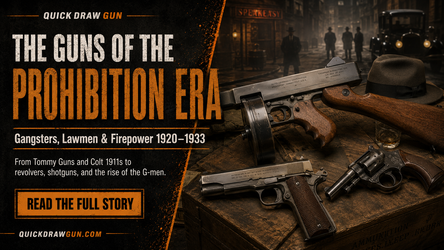
The Guns of the Prohibition Era
Posted by Quick Draw Gun on Jun 16th 2026
The Prohibition era created one of the most infamous chapters in American firearms history. From 1920 to 1933, the United States banned the manufacture, sale, and transportation of alcoholic beverages under the 18th Amendment and the Volstead Act. Instead of eliminating alcohol, Prohibition helped fuel a black-market economy where bootleggers, mobsters, smugglers, and corrupt officials fought for control of illegal liquor profits.
That world needed muscle. Speakeasies needed protection. Trucks carrying illegal liquor needed armed guards. Rival gangs fought over territory. Police departments, federal agents, and local sheriffs suddenly found themselves facing criminals with fast cars, cash, and serious firepower.
The firearms of the Prohibition era became symbols of the Roaring Twenties: the Thompson submachine gun, sawed-off shotguns, Colt pistols, Smith & Wesson revolvers, Winchester rifles, and eventually the heavier weapons that appeared during the transition into the Great Depression gangster years.
Why Prohibition Changed American Crime
Before Prohibition, organized crime existed, but illegal alcohol created a massive new business. Criminal groups could make money producing, transporting, and selling liquor. That money allowed gangs to buy cars, bribe officials, hire gunmen, and arm themselves better than many local police departments.
Major cities like Chicago, New York, Detroit, St. Louis, and Kansas City became battlegrounds for criminal organizations. Rural areas also saw violence as moonshiners and bootleggers moved liquor through back roads, rivers, rail lines, and hidden supply routes.
This was not just a city problem. It was a national crime wave.
The Thompson Submachine Gun: The Icon of the Era
No firearm is more closely connected to the Prohibition era than the Thompson submachine gun, better known as the Tommy Gun.
Originally developed after World War I, the Thompson was chambered in .45 ACP and could fire at a rapid rate. Its famous drum magazine and vertical foregrip made it instantly recognizable. During the 1920s and early 1930s, it became associated with mob violence, bank robbers, and law enforcement officers trying to stop them.
The Thompson gained national notoriety in part because of its connection to gangland violence and events like the St. Valentine’s Day Massacre. It became one of the most visible symbols of organized crime in the public imagination.
Why Gangsters Wanted It
The Thompson offered:
- Rapid automatic fire
- Heavy .45 ACP impact
- Intimidation value
- Firepower against rival gangs
- Ability to dominate close-range fights
It was expensive, heavy, and not always practical—but it looked terrifying, sounded terrifying, and made headlines.
Why Lawmen Used It Too
Police departments, prison guards, federal agents, and other law enforcement groups also adopted Thompson submachine guns. They needed a way to match the firepower of criminals who were no longer limited to revolvers and shotguns.
By the early 1930s, the Thompson had become both a gangster weapon and a lawman’s weapon.
The Colt 1911: Serious Sidearm Power
The Colt 1911 was already a respected military sidearm by the time Prohibition began. Chambered in .45 ACP, it offered semi-automatic fire, strong stopping power, and proven reliability.
During the Prohibition era, the 1911 appeared in the hands of:
- Police officers
- Federal agents
- Military veterans
- Private security
- Criminal gunmen
The 1911 was slimmer and faster to reload than many revolvers of the period, making it attractive to anyone who wanted a serious fighting pistol.
Why It Mattered
In a time when many officers still carried revolvers, the 1911 represented modern handgun firepower. It was not as flashy as a Tommy Gun, but in close-range confrontations it was one of the most capable pistols available.
Revolvers: The Everyday Guns of Lawmen and Criminals
Despite the fame of the Thompson and 1911, revolvers were still the most common handguns of the Prohibition era. They were simple, rugged, and widely available.
Common revolvers included:
- Colt Police Positive
- Colt Official Police
- Colt Detective Special
- Smith & Wesson Military & Police
- Smith & Wesson Hand Ejector models
- Large-frame revolvers in .38 Special, .44, and .45 calibers
Why Revolvers Stayed Popular
Revolvers were trusted because they were:
- Easy to operate
- Mechanically dependable
- Familiar to police officers
- Available in multiple calibers
- Easy to carry concealed
For most local officers, a revolver was the daily working gun. For many criminals, it was the easiest handgun to obtain and conceal.
Sawed-Off Shotguns: Close-Range Intimidation
The sawed-off shotgun became another infamous Prohibition-era firearm. Criminals valued short-barreled shotguns because they were powerful, concealable, and devastating at close range.
Bootleggers, bank robbers, and gang enforcers could hide a shortened shotgun under a coat, behind a car seat, or inside a vehicle.
Common shotgun types included:
- Double-barrel shotguns
- Winchester Model 1897 pump shotguns
- Winchester Model 12 shotguns
- Remington pump shotguns
- Shortened hunting shotguns
Why They Were Feared
A shotgun did not need glamour to be effective. At close distance, it offered massive intimidation and stopping power. That made it useful for robberies, ambushes, liquor transport protection, and law enforcement raids.
The popularity of short-barreled shotguns and machine guns later helped shape federal firearms regulation. The National Firearms Act of 1934 placed strict controls on weapons such as machine guns and short-barreled shotguns, reflecting public concern over “gangster weapons” during the period.
Winchester Rifles and Lever Actions
Not every Prohibition-era fight happened in a Chicago alley. Outside the cities, bootlegging often happened across farms, hills, river crossings, and rural roads. In those places, rifles mattered.
Common rifles included:
- Winchester lever-action rifles
- Remington sporting rifles
- Bolt-action rifles
- Surplus military rifles
- Winchester Model 1907 semi-automatic rifles
Lawmen, guards, ranchers, and criminals all used rifles when distance mattered.
The Winchester Model 1907
The Winchester Model 1907 deserves special mention. It was a semi-automatic rifle chambered in .351 Winchester Self-Loading and was used by some law enforcement agencies. It offered more reach than a handgun and faster follow-up shots than a bolt-action rifle.
It later became especially associated with early 20th-century law enforcement and criminal manhunts.
The Browning Automatic Rifle: Heavy Firepower Arrives
The Browning Automatic Rifle, or BAR, was not the everyday weapon of Prohibition-era bootleggers, but it became important in the later gangster era of the early 1930s. Criminals such as Clyde Barrow favored stolen military-style firepower, and the BAR represented a major escalation.
The BAR fired a powerful rifle cartridge and could defeat vehicle cover far better than handgun rounds or buckshot. That made it a nightmare for law enforcement when criminals got their hands on one.
Why It Mattered
The BAR showed that criminals were not just carrying pistols anymore. They were using military-grade weapons in robberies, ambushes, and escapes. That forced law enforcement to rethink tactics, roadblocks, armor, and long guns.
Bootleggers, Cars, and Guns
Prohibition crime was tied closely to the automobile. Fast cars allowed bootleggers to outrun local officers, move liquor quickly, and cross county or state lines.
A typical bootlegger vehicle might include:
- A revolver under the seat
- A shotgun in the back
- A rifle for longer-range protection
- Hidden compartments for liquor
- Reinforced suspension for heavy loads
This combination of cars, guns, and illegal profit made Prohibition violence different from earlier outlaw crime. Criminals were more mobile, better funded, and harder to contain.
Lawmen of the Prohibition Era
The public often remembers gangsters first, but law enforcement was also evolving quickly.
Different agencies fought Prohibition-era crime:
- Local police departments
- County sheriffs
- State police
- Treasury Department agents
- Prohibition Bureau agents
- Postal inspectors
- Early FBI agents
- Private security and bank guards
At first, many officers were outgunned or outmaneuvered. Some departments still relied heavily on revolvers and shotguns. As violence increased, more agencies began adopting heavier weapons.
The FBI’s later pursuit of Depression-era criminals like John Dillinger helped define the “G-man” image. Dillinger’s gang, for example, robbed banks and police arsenals, committed jail breaks, and terrorized parts of the Midwest from 1933 to 1934.
Famous Firearms of Prohibition-Era Crime
Thompson Submachine Gun
The signature gangster firearm of the era.
Colt 1911
A powerful semi-auto pistol used by military veterans, police, agents, and criminals.
Smith & Wesson Revolvers
Common working guns for police officers and civilians.
Colt Police Revolvers
Widely carried by law enforcement and private citizens.
Winchester Model 1897
A pump shotgun with serious close-range capability.
Winchester Model 12
Another respected pump shotgun used by both civilians and law enforcement.
Winchester Model 1907
A semi-auto rifle used by some police agencies and security forces.
Browning Automatic Rifle
A later escalation weapon associated with the violent gangster era.
How Prohibition Firearms Changed Gun Laws
The violence of the Prohibition and gangster eras helped push the federal government toward new firearms regulation.
The National Firearms Act of 1934 became one of the most important firearm laws in American history. It regulated machine guns, short-barreled shotguns, short-barreled rifles, silencers, and certain other firearms through taxation and registration. The public image of criminals using Tommy Guns and sawed-off shotguns played a major role in the political pressure behind that law.
While Prohibition officially ended in 1933, the crime wave it helped fuel continued shaping American law enforcement, firearms culture, and public policy well into the 1930s.
Why Collectors Still Love Prohibition-Era Firearms
Prohibition-era firearms remain popular with collectors because they connect to one of the most dramatic periods in American history.
Collectors are drawn to:
- Thompson submachine guns
- Colt 1911 pistols
- Period police revolvers
- Winchester shotguns
- Law enforcement-marked rifles
- Bank guard and prison guard guns
- Firearms tied to famous criminals or agencies
A firearm from this era does not just represent steel and wood. It represents speakeasies, bank guards, back-road bootlegging, federal raids, mob violence, and the birth of modern American law enforcement.
Final Thoughts
The guns of the Prohibition era tell the story of a country struggling with crime, corruption, technology, and law enforcement modernization.
Gangsters made the Thompson famous. Lawmen made it a tool of justice. Revolvers remained the daily workhorses. Shotguns ruled close quarters. Rifles protected roads, banks, and shipments. And by the early 1930s, weapons like the BAR showed just how dangerous the crime wave had become.
Prohibition may have ended in 1933, but the firearms of that era remain some of the most recognizable and historically fascinating guns ever carried in America.
Frequently Asked Questions
What was the most famous gun of the Prohibition era?
The Thompson submachine gun is the most famous firearm associated with the Prohibition era, especially because of its connection to organized crime and law enforcement.
Did gangsters really use Tommy Guns?
Yes. Thompson submachine guns were used by some gangsters and were heavily publicized in newspapers, movies, and crime stories of the era.
What handguns were common during Prohibition?
Common handguns included Colt and Smith & Wesson revolvers, along with semi-automatic pistols such as the Colt 1911.
Did police carry machine guns during Prohibition?
Some law enforcement agencies adopted Thompson submachine guns and other heavier firearms as criminal firepower increased.
What gun laws came from the gangster era?
The National Firearms Act of 1934 was heavily influenced by public concern over machine guns, short-barreled shotguns, and other weapons associated with gangland violence.