
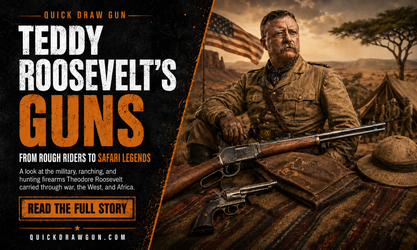
The Firearms Teddy Roosevelt Used Over His Lifetime
Jun 5th 2026
Theodore Roosevelt was not just a president, soldier, rancher, hunter, and conservationist—he was also one of the most famous American firearms enthusiasts of his era. His guns were not wall-hangers. Roosevelt carried them in Cuba with the Rough Riders, packed them across the Dakota Badlands, and took them on some of the most famous hunting expeditions of the early 20th century.
Not every firearm ever associated with Roosevelt can be proven with the same level of certainty. Some survive in museum collections, some are documented in letters and books, and others are tied to his military unit or hunting expeditions through historical accounts. But together, they tell the story of a man who understood firearms as tools of war, survival, sport, and history.
Roosevelt the Soldier: Firearms of the Rough Riders
Before Roosevelt became president, he resigned as Assistant Secretary of the Navy to help organize the 1st U.S. Volunteer Cavalry during the Spanish-American War. The unit became famous as the Rough Riders, and Roosevelt made sure they were better armed than many volunteer units of the time.
Krag-Jørgensen Carbine
The main shoulder arm of the Rough Riders was the Krag-Jørgensen carbine, chambered in .30-40 Krag. Roosevelt wrote in The Rough Riders that the regiment was armed with the same Krag-Jørgensen carbine used by regular cavalry units. That mattered because the Krag used smokeless powder and was far more modern than older blackpowder arms still floating around at the time.
For the Rough Riders, the Krag gave them a modern repeating carbine suited for mounted troops, skirmishing, and the rough terrain of Cuba.
Colt Revolvers
The Rough Riders also carried revolvers, and Roosevelt himself is famously connected to a Colt Navy Model 1895 .38 caliber revolver recovered from the wreck of the USS Maine. The Naval History and Heritage Command identifies a Colt “New Navy” M1895 revolver recovered from the Maine, and Justice Department records note the inscription tying Roosevelt’s revolver to San Juan on July 1, 1898.
This sidearm became one of the most famous Roosevelt firearms because of its connection to both the USS Maine and the charge up the San Juan Heights.
Smith & Wesson New Model No. 3
Roosevelt also owned a Smith & Wesson New Model No. 3 revolver chambered in .38 Long Colt. Factory records attribute the revolver to Roosevelt, and the Boone and Crockett Club notes that it was shipped to Lt. Col. Roosevelt on May 12, 1898—the same day he left for San Antonio to train the Rough Riders.
While the Colt from the Maine is the revolver most often tied to San Juan Hill, the Smith & Wesson shows how serious Roosevelt was about being properly armed before going to war.
Winchester Model 1895 in .30-40 Krag
Roosevelt was also associated with the Winchester Model 1895 during the Rough Riders period. Historical accounts note that officers of the regiment received Winchester Model 1895 rifles, and Shooting Illustrated reports that Roosevelt took an M1895 carbine chambered in .30-40 Krag to Cuba and loaned it to Trooper Bob Wrenn, who carried it into battle.
The Model 1895 was a major step forward for lever-action rifles because its box magazine allowed it to use pointed, more powerful military-style cartridges.
Colt-Browning Model 1895 Machine Guns
The Rough Riders also had access to a pair of Colt-Browning Model 1895 machine guns, often called “Potato Diggers.” American Rifleman notes that Roosevelt’s Rough Riders took two Colt-Browning machine guns to Cuba in 1898, and that one example is now displayed at the National Firearms Museum.
These guns were not Roosevelt’s personal sidearms, but they were part of the firepower connected to his regiment and the changing nature of warfare.
Roosevelt the Rancher: Dakota Badlands Firearms
Before the White House and before Cuba, Roosevelt spent time ranching and hunting in the Dakota Badlands. This period shaped his identity as a Western sportsman.
Winchester Model 1876
One of the most important rifles tied to Roosevelt’s ranching years was the Winchester Model 1876. The Model 1876 was a larger, more powerful lever-action rifle than the earlier Model 1873 and was well suited for big game of the era. Historical firearm accounts connect Roosevelt to Model 1876 rifles during his Dakota hunting years, including rifles chambered in powerful cartridges such as .45-75 Winchester.
For Roosevelt, the Winchester 1876 represented the working rifle of the American frontier—powerful enough for large game and rugged enough for hard use in bad country.
Winchester Model 1873
Roosevelt also owned and ordered Winchester rifles beyond the 1876, including a Winchester Model 1873 in .32-20 according to American Rifleman’s discussion of Roosevelt’s Winchester rifles.
While the 1873 was not his biggest-game rifle, it shows Roosevelt’s long-running connection to Winchester lever guns.
Roosevelt the Hunter: North American Sporting Arms
Roosevelt’s life as a hunter was not limited to Africa. He hunted throughout North America, and his firearm choices reflected the game, terrain, and technology of his time.
Lever-Action Rifles
Roosevelt favored practical rifles that could stand up to real use. His connection to Winchester lever-actions—especially the Model 1876 and Model 1895—fits his personality perfectly. These were not fragile sporting pieces. They were working rifles for rough country.
Shotguns
Roosevelt also appreciated fine shotguns. The National Firearms Museum’s Roosevelt-related gallery references Purdey double rifles and shotguns, Parker shotguns, and other elegant arms connected to Roosevelt’s era and collection.
This side of Roosevelt is important because he was not only a military man or big-game hunter. He was also a sportsman who understood craftsmanship.
Roosevelt in Africa: The Famous Safari Battery
After leaving the presidency in 1909, Roosevelt led the Smithsonian-Roosevelt African Expedition. It was one of the most famous hunting and scientific expeditions of the period. The Cody Firearms Museum notes that the expedition brought extensive firearms and ammunition, including Roosevelt’s Winchester Model 1895 in .405 WCF.
Winchester Model 1895 .405 Winchester
The most famous Roosevelt hunting rifle is almost certainly the Winchester Model 1895 chambered in .405 Winchester.
Roosevelt made the rifle legendary in African Game Trails when he described the .405 Winchester as his “medicine gun” for lions. American Rifleman also notes Roosevelt’s quote that the Winchester .405 was, for him personally, the “medicine gun for lions.”
That line helped make the .405 Winchester one of the most famous big-game cartridges in American sporting history.
Winchester Model 1895 in .30-03 / .30-06 Family
Roosevelt’s African battery also included other modern rifles. Big-game hunting sources discussing African Game Trails note that Roosevelt and Kermit brought multiple Model 1895 Winchesters, including .405 rifles and a .30-03 Springfield-chambered rifle for Kermit.
This shows that Roosevelt was not locked into one firearm type. He brought rifles suited to different hunting roles.
Springfield Model 1903
Roosevelt also used a Springfield Model 1903 on safari. Accounts of his African battery include a sporterized Springfield in .30-06, which represented the new generation of American bolt-action sporting and military rifle design.
The Springfield 1903 made sense for Roosevelt. It was accurate, modern, and American.
Holland & Holland Double Rifle
For dangerous game, Roosevelt carried a Holland & Holland double rifle, commonly associated with powerful Nitro Express chamberings. Historical accounts of Roosevelt’s African battery list the Holland & Holland double rifle among his major safari arms.
A double rifle was the classic dangerous-game firearm of the period. When facing elephant, lion, buffalo, or rhino, hunters valued the immediate second shot and reliability of a high-grade double.
A.H. Fox F Grade Shotgun
One of Roosevelt’s most admired sporting arms was his A.H. Fox F Grade shotgun. The Theodore Roosevelt Center preserves a letter in which Roosevelt said the double-barreled shotgun was “the most beautiful gun he has ever seen,” and museum accounts note that the gun accompanied him on his 1909 African safari.
The Fox shotgun shows Roosevelt’s appreciation for American-made sporting craftsmanship.
Roosevelt’s Firearms Were Tools, Not Props
What stands out about Roosevelt’s guns is that they were used. They were carried in war, packed on horseback, taken into rough country, and selected for specific purposes.
His firearms tell us several things about him:
- He liked modern technology when it worked.
- He valued reliability over appearance alone.
- He appreciated fine craftsmanship.
- He believed a firearm should fit the job.
- He treated hunting as both sport and fieldcraft.
That is why his firearms remain so interesting to collectors today. They were not just owned by a famous president. They were part of the way Roosevelt lived.
Most Famous Teddy Roosevelt Firearms
Colt Navy Model 1895 Revolver
Connected to the USS Maine and San Juan Hill.
Smith & Wesson New Model No. 3
A documented Roosevelt revolver shipped to him during the Rough Riders period.
Krag-Jørgensen Carbine
The primary carbine of the Rough Riders.
Winchester Model 1895 .30-40 Krag
Associated with Roosevelt’s Cuba service.
Winchester Model 1876
A major rifle of his Dakota Badlands hunting years.
Winchester Model 1895 .405 Winchester
His famous African safari “medicine gun” for lions.
Springfield Model 1903
A modern American bolt-action rifle used during his safari period.
Holland & Holland Double Rifle
A dangerous-game rifle for Africa.
A.H. Fox F Grade Shotgun
One of the finest shotguns Roosevelt ever owned.
Why Collectors Still Care
Roosevelt firearms bring together multiple collector categories:
- Presidential history
- Spanish-American War history
- American West history
- Winchester collecting
- Fine sporting arms
- African safari history
- Conservation history
Few historical figures connect so many firearm worlds at once. A Roosevelt-associated gun is not just a firearm—it is a link to the Rough Riders, the American frontier, the White House, and the golden age of big-game hunting.
Final Thoughts
Theodore Roosevelt’s firearms were as varied as his life. He carried revolvers and carbines in Cuba, relied on Winchester lever guns in the West, and took carefully selected rifles and shotguns to Africa.
From the Colt revolver tied to San Juan Hill to the Winchester .405 he called his “medicine gun” for lions, Roosevelt’s firearms reflect a man who believed in action, preparation, and personal responsibility.
For collectors and historians, his guns are more than famous artifacts. They are mechanical snapshots of one of the most active and adventurous lives ever lived by an American president.