
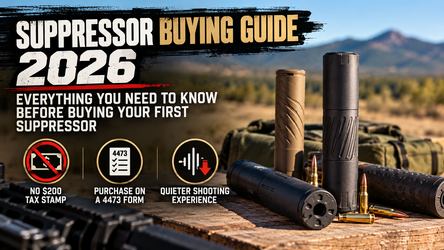
Suppressor Buying Guide 2026 | New 4473 Rules
Posted by Quick Draw Gun on Oct 30th 2026
Suppressor Buying Guide 2026: No $200 Tax Stamp, No Form 4 Wait — What You Need to Know
Suppressor ownership has entered a new era in 2026. For decades, purchasing a firearm suppressor meant navigating the National Firearms Act (NFA), paying a $200 federal transfer tax, submitting paperwork, and waiting for ATF approval.
That process has changed dramatically.
Beginning January 1, 2026, the federal transfer tax on suppressors dropped to $0. Then, on October 9, 2026, the Bureau of Alcohol, Tobacco, Firearms and Explosives (ATF) announced that it would no longer enforce NFA registration and preapproval requirements for suppressors under its nationwide enforcement policy.
For eligible customers in states where suppressors are legal, this means purchasing a suppressor through a licensed firearms dealer can now involve the familiar ATF Form 4473 and background-check process, without the traditional Form 4 approval wait.
If you've considered owning a suppressor but were discouraged by the cost and paperwork, 2026 marks a significant turning point.
What Is a Firearm Suppressor?
A firearm suppressor, sometimes called a silencer, is a device designed to reduce the sound and muzzle blast produced when a firearm is discharged.
Suppressors work by containing and slowing the release of high-pressure gases as they exit the firearm's muzzle.
Despite how suppressors are often portrayed in movies, they do not make gunfire completely silent.
The level of sound reduction depends on several factors, including firearm configuration, ammunition, caliber, and suppressor design. Supersonic ammunition also produces a ballistic crack that a muzzle-mounted suppressor cannot eliminate.
Suppressors are widely used for recreational shooting, hunting, and precision rifle applications.
What Changed With Suppressor Laws in 2026?
Two major federal developments changed the suppressor purchasing landscape.
January 1, 2026: The $200 Federal Tax Was Eliminated
Federal legislation reduced the making and transfer tax on suppressors from $200 to $0.
This eliminated a longstanding additional expense associated with suppressor ownership.
Initially, the traditional NFA application and registration procedures remained in place despite the elimination of the tax.
October 9, 2026: ATF Announced New Suppressor Transfer Guidance
Following federal litigation and a decision not to appeal a district court ruling, ATF announced a nationwide policy of not enforcing NFA registration, tax-stamp, and preapproval requirements for suppressors and certain other covered firearms.
Under the new guidance, federally licensed dealers process eligible suppressor transfers under the Gun Control Act, including Form 4473, the required NICS background check, and dealer recordkeeping.
The important distinction: Suppressors have not been formally deleted from the NFA's statutory definitions. Rather, the federal government has adopted a non-enforcement policy for specified NFA requirements.
That distinction matters because the policy could change through future court decisions, legislation, or federal enforcement decisions.
State and local laws also remain in effect.
Can You Buy a Suppressor With a Form 4473 in 2026?
Under ATF's October 9, 2026 guidance, eligible suppressor purchases through federally licensed dealers can be completed using the standard Form 4473 and applicable background-check process, provided the transaction complies with state and local law.
This is a major departure from the traditional suppressor purchasing process.
Customers no longer necessarily need to wait for federal Form 4 approval before taking possession under the current nationwide enforcement guidance.
However, Form 4473 is not an exemption from firearms laws. Purchasers must still be legally eligible to possess firearms, and licensed dealers must follow applicable transfer, identification, background-check, and recordkeeping requirements.
In addition, certain states have laws that may still require NFA registration or otherwise restrict suppressor possession. ATF continues to accept voluntary NFA applications where necessary or desired.
Before purchasing, confirm the applicable requirements with your dealer.
Why Do Firearm Owners Use Suppressors?
1. Reduced Muzzle Blast
One of the primary advantages of a suppressor is reducing the sound pressure associated with the firearm's muzzle blast.
Although suppressors do not eliminate gunfire noise, they can make the shooting experience more comfortable.
Hearing protection remains recommended even when using a suppressor.
2. Reduced Noise Exposure Around Others
Suppressors can help reduce noise exposure for people nearby, including other shooters and individuals in surrounding areas.
This can be particularly relevant at shooting ranges and during lawful hunting activities.
3. A More Comfortable Shooting Experience
Reducing muzzle blast can improve the overall shooting experience, especially during extended recreational shooting sessions.
Depending on the firearm and suppressor, users may also experience changes in perceived recoil and muzzle movement.
4. Hunting Applications
Suppressors have become increasingly popular among hunters who value reduced muzzle blast and noise exposure.
However, suppressor use while hunting is governed by state wildlife regulations, which should be checked separately from firearm possession laws.
Rimfire, Pistol, and Rifle Suppressors: What's the Difference?
Not all suppressors are designed for the same applications.
Rimfire Suppressors
Rimfire suppressors are commonly associated with .22 LR firearms.
They are generally compact and lightweight, making them a popular category for recreational shooting and small-game hunting where permitted.
Because rimfire ammunition can produce substantial fouling, maintenance characteristics are an important consideration.
Pistol Suppressors
Pistol suppressors are designed for compatible handgun cartridges, commonly including 9mm and .45 ACP.
They vary in size, weight, mounting systems, and rated cartridge compatibility.
Rifle Suppressors
Rifle suppressors are designed to handle the pressures and operating conditions associated with compatible centerfire rifle cartridges.
Popular rifle suppressor categories include models rated for .223/5.56 NATO, .308 Winchester, and various hunting cartridges.
A suppressor's specific caliber and firearm compatibility must always be confirmed with the manufacturer.
What Should You Consider Before Choosing Your First Suppressor?
Several factors can influence which suppressor is appropriate for a particular firearm.
Caliber compatibility: A suppressor must be rated for the ammunition and firearm configuration in which it will be used.
Size and weight: Different suppressors offer different balances of portability, weight, and sound-reduction performance.
Construction: Suppressors may use stainless steel, titanium, or other specialized materials, depending on their intended applications.
Maintenance: Some suppressors are designed to be disassembled for cleaning, while others use sealed construction.
Manufacturer support: Warranty coverage, documentation, and manufacturer service are important considerations for a durable firearm accessory.
Legal requirements: State and local laws may impose additional restrictions even when federal enforcement requirements change.
Suppressor Ownership in Missouri
Missouri is among the states where civilian suppressor ownership is generally permitted for individuals who satisfy applicable legal requirements.
For Missouri firearm owners, the 2026 federal changes may substantially simplify the purchase process.
Under ATF's current guidance, eligible suppressor transfers through licensed dealers may be processed using Form 4473 and the required background check rather than the traditional federal Form 4 approval process.
Missouri residents should still confirm applicable state requirements and the dealer's current transfer procedures before completing a transaction.
Frequently Asked Questions About Suppressors in 2026
Do suppressors still require a $200 tax stamp?
No. The federal making and transfer tax for suppressors was reduced to $0 effective January 1, 2026.
Are suppressors still classified under the NFA?
Yes, suppressors remain within the NFA's statutory definitions. However, ATF announced on October 9, 2026, that it would no longer enforce certain NFA registration and approval requirements for suppressors under its nationwide policy.
Can I buy a suppressor using Form 4473?
Under current ATF guidance, eligible dealer transfers can be completed using Form 4473 and the applicable NICS background check, subject to state and local law.
Do I still need to file ATF Form 4?
ATF is not currently enforcing the federal Form 4 preapproval requirement for covered suppressor transfers. However, some state laws may still require registration, and voluntary Form 4 processing remains available.
Do I still need a background check?
Yes. Licensed dealers must conduct the required background check unless an applicable legal exemption applies.
Are suppressors legal in Missouri?
Suppressor ownership is generally lawful in Missouri for eligible individuals, subject to applicable federal and state requirements.
Can I hunt with a suppressor in Missouri?
Suppressor use is generally permitted for lawful hunting in Missouri, subject to current Missouri Department of Conservation regulations and applicable hunting rules.
Are suppressors completely silent?
No. Suppressors reduce muzzle blast but do not eliminate all firearm noise. Hearing protection remains important.
Could the 2026 suppressor rules change again?
Yes. The current federal non-enforcement policy does not repeal the underlying NFA provisions. Future litigation, legislation, or administrative decisions could affect how suppressors are regulated.
A New Chapter for Suppressor Ownership
For years, the traditional suppressor purchase process involved an additional $200 tax and federal approval requirements that discouraged some firearm owners from considering suppressor ownership.
The changes in 2026 have removed major federal barriers under current ATF guidance.
With the federal transfer tax reduced to $0 and eligible dealer transfers now proceeding through Form 4473 and background checks without the traditional Form 4 approval wait, suppressor ownership has become more accessible in states where possession is lawful.
Understanding the current rules, selecting compatible equipment, and following applicable state and federal requirements remain essential.
For Missouri firearm owners interested in learning more about suppressors, Quick Draw Gun is a resource for firearm education, product information, and current purchasing requirements.
Contact Quick Draw Gun to learn more about suppressors and current transfer procedures.
**Legal information current as of October 28, 2026. Federal enforcement guidance and state laws may change. This article is for general educational purposes and is not legal advice.**