
Remington Model 11: America’s First Semi-Auto Shotgun and Its Role in WWII
Posted by Quick Draw Gun on May 1st 2026
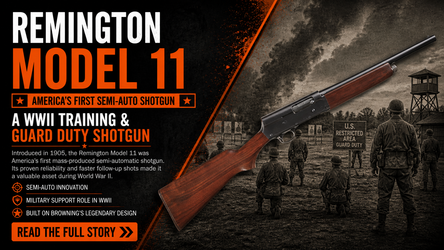
The Remington Model 11 stands as a milestone in American firearms history. Introduced in 1905, it became the first mass-produced semi-automatic shotgun in the United States, setting the foundation for every semi-auto shotgun that followed.
While widely known for hunting and sporting use, the Model 11 also played a lesser-known but important role during World War II, proving that semi-automatic shotguns had a place in military service.
Origins of the Remington Model 11
The Model 11 traces directly back to John Moses Browning, whose revolutionary shotgun design would change firearms forever.
After Browning’s design was declined by Winchester, it was produced by Fabrique Nationale (FN) as the Browning Auto-5. Remington later secured the rights to manufacture the design in the U.S., launching the Remington Model 11 in 1905.
This made it the first widely available semi-auto shotgun for American shooters.
A Breakthrough in Shotgun Design
Before the Model 11, most shotguns required manual operation:
- Pump-action
- Break-action
- Single-shot
The Model 11 introduced semi-automatic fire, allowing shooters to fire successive shots without manually cycling the action.
This innovation provided:
- Faster follow-up shots
- Improved efficiency in hunting
- A major leap forward in firearm technology
How the Model 11 Operates
The Model 11 uses a long recoil system, one of Browning’s most innovative designs.
Operation cycle:
- Barrel and bolt recoil together after firing
- Barrel returns forward first
- Bolt follows, chambering the next round
This system made the Model 11:
- Extremely durable
- Reliable across various loads
- Capable in harsh conditions
Key Features of the Remington Model 11
Humpback Receiver Design
The distinctive “humpback” profile provides a longer sight plane, improving target tracking.
Solid Construction
Built with steel and walnut, the Model 11 was designed for longevity and rugged use.
Versatility
Available in multiple gauges, it was suitable for hunting, sport shooting, and utility roles.
Remington Model 11 in WWII
While not as widely issued as pump-action trench guns, the Remington Model 11 did see service during World War II, primarily in specialized and support roles.
Military Roles
During WWII, the Model 11 was used for:
- Training purposes
- Guard and security duty
- Base and facility protection
- Limited combat support roles
Its semi-automatic capability gave it an advantage in close-range defensive scenarios where rapid follow-up shots were critical.
Why It Was Used
The Model 11 was selected for certain roles due to:
- Proven reliability from decades of civilian use
- Semi-automatic fire capability
- Availability of production and existing inventory
However, it was not the primary combat shotgun of the war.
Compared to Other WWII Shotguns
The Model 11 competed with and complemented other military shotguns:
Winchester Model 1897
- Pump-action
- Widely used in trench warfare
- Known for durability and simplicity
Winchester Model 1912
- Improved pump-action design
- Became a standard military shotgun
Remington Model 11
- Semi-automatic
- Faster firing capability
- More complex mechanically
Because of its more complex recoil system, the Model 11 was less common in front-line combat, but still valuable in support roles.
Limitations in Military Use
Despite its advantages, the Model 11 had some drawbacks for military adoption:
- More complex maintenance compared to pump shotguns
- Sensitivity to certain loads due to recoil system adjustments
- Heavier and more intricate operation
These factors limited its widespread battlefield use but did not diminish its effectiveness in the roles it filled.
Hunting and Civilian Popularity
Outside of military use, the Model 11 became extremely popular among American hunters.
It excelled in:
- Waterfowl hunting
- Upland game
- General sporting use
The ability to fire rapid follow-up shots gave hunters a clear advantage in the field.
Model 11 vs Browning Auto-5
The Remington Model 11 and Browning Auto-5 share the same DNA.
Similarities
- Long recoil system
- Humpback design
- Proven reliability
Differences
- Manufactured by different companies
- Slight variations in finish and configuration
Both remain iconic firearms in their own right.
End of Production and Evolution
Production of the Model 11 continued until 1947, when it was replaced by more modern designs like the Remington 11-48.
These newer shotguns offered:
- Lighter weight
- Simplified operation
- Improved recoil handling
Collectibility Today
The Remington Model 11 is now a highly sought-after collector’s piece.
Collectors look for:
- Early production models
- Military-marked examples
- Well-preserved original finishes
WWII-era Model 11 shotguns with documented use are especially desirable.
Legacy of the Remington Model 11
The Model 11 proved that semi-automatic shotguns could be:
- Reliable
- Practical
- Effective in both civilian and military roles
It laid the groundwork for modern semi-auto shotguns used today in hunting, sport shooting, and tactical applications.
Final Thoughts
The Remington Model 11 is more than just a historic shotgun—it is a pioneering design that changed the trajectory of firearm development.
Its role in WWII, while not as prominent as pump-action shotguns, highlights its versatility and reliability in real-world conditions.
For collectors, historians, and enthusiasts, the Model 11 remains a true American classic.
Explore Historic Shotguns at Quick Draw Gun
At QuickDrawGun.com, we carry firearms that reflect the evolution of design and performance—from historic shotguns like the Model 11 to modern platforms built on its legacy.