
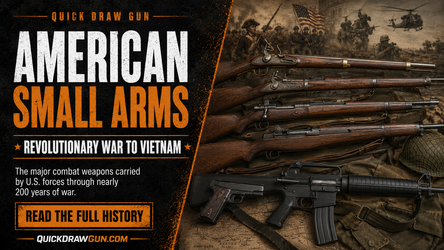
Major American Small Arms Used in Combat: Revolutionary War to Vietnam
Posted by Quick Draw Gun on May 27th 2026
From flintlock muskets to select-fire rifles, American military small arms evolved dramatically between the Revolutionary War and Vietnam. Each conflict pushed firearm technology forward—sometimes slowly, sometimes all at once. Smoothbore muskets gave way to rifled muskets, then bolt-action rifles, semi-automatics, submachine guns, carbines, and eventually modern assault rifles.
This guide covers the major small arms used by American forces in combat from the Revolutionary War through the Vietnam War.
Revolutionary War: Flintlocks, Muskets, and Rifles
During the American Revolution, the standard infantry weapon was the flintlock musket. These arms were slow to load, inaccurate by modern standards, and most effective when fired in volleys. Still, they defined 18th-century warfare.
Brown Bess Musket
The British Brown Bess was one of the most common muskets of the Revolutionary War. Many American forces used captured or previously owned Brown Bess muskets.
Why it mattered:
It was rugged, simple, and widely available. While not especially accurate, it was effective in massed fire.
Charleville Musket
The French Charleville musket became extremely important to American forces after France entered the war. French arms helped supply the Continental Army when American manufacturing could not meet demand.
Why it mattered:
The Charleville became one of the most important foreign-supplied muskets of the Revolution.
Pennsylvania / Kentucky Long Rifle
The American long rifle, often called the Pennsylvania rifle or Kentucky rifle, was far more accurate than smoothbore muskets. It was commonly used by frontiersmen and riflemen.
Why it mattered:
It gave skilled marksmen greater accuracy at longer distances, though it was slower to load and lacked a bayonet.
War of 1812: Flintlocks Still Rule
The War of 1812 was still largely a flintlock musket war. American forces used a mix of older Revolutionary War-era arms and newer domestic muskets.
U.S. Model 1795 Musket
The Model 1795 was one of the first standardized U.S.-made military muskets.
Why it mattered:
It represented America’s growing ability to manufacture its own military arms.
U.S. Model 1812 / Model 1816 Musket
These flintlock muskets continued the American move toward standardized military production.
Why it mattered:
They became common service arms and remained in use for decades, with many later converted to percussion ignition.
Rifles and Militia Arms
American riflemen still used long rifles and various privately owned arms, especially on the frontier.
Why it mattered:
Militia and frontier forces often brought their own firearms, creating wide variation in arms used during the conflict.
Mexican-American War: The Transition Begins
By the Mexican-American War, the U.S. military was beginning to move toward improved ignition systems and better standardized arms.
U.S. Model 1842 Musket
The Model 1842 was the first U.S. regulation musket made as a percussion firearm rather than flintlock.
Why it mattered:
Percussion caps were more reliable than flintlocks, especially in bad weather.
Hall Rifle and Carbines
The Hall rifle was an early breechloading firearm used in limited numbers.
Why it mattered:
Although not perfect, it showed the potential of breechloading small arms.
Colt Paterson and Early Revolvers
Early Colt revolvers saw limited use and hinted at the coming importance of repeating handguns.
Why it mattered:
The idea of multiple shots before reloading would become increasingly important in American warfare.
Civil War: Rifled Muskets, Repeaters, and Revolvers
The Civil War was one of the most important turning points in small arms history. Traditional tactics collided with more accurate, longer-range firearms.
Springfield Model 1861 Rifle-Musket
The Springfield Model 1861 was one of the most important Union infantry weapons of the war.
Why it mattered:
Its rifled barrel and .58 caliber Minié ball made it far more accurate than older smoothbores.
Pattern 1853 Enfield Rifle-Musket
The British-made Enfield was used by both Union and Confederate forces.
Why it mattered:
It was accurate, reliable, and imported in large numbers.
Spencer Repeating Rifle and Carbine
The Spencer was a repeating firearm with a seven-round magazine.
Why it mattered:
It gave Union troops significantly more firepower than single-shot muzzleloaders.
Henry Rifle
The Henry repeating rifle held up to 16 rounds and became famous for its rapid fire.
Why it mattered:
Though not issued in huge numbers, it showed the future of repeating military firearms.
Sharps Carbine
The Sharps was a breechloading carbine widely used by cavalry and sharpshooters.
Why it mattered:
It was faster to reload than muzzleloaders and highly respected for accuracy.
Colt 1860 Army Revolver
The Colt 1860 Army was one of the most common sidearms of the Civil War.
Why it mattered:
Its six-shot capacity made it valuable for cavalry, officers, and close-range fighting.
Remington 1858 New Model Army
The Remington 1858 was another major percussion revolver.
Why it mattered:
Its solid-frame design made it durable and respected by soldiers.
Indian Wars and Frontier Era: Trapdoors, Carbines, and Sixguns
After the Civil War, the U.S. military continued using converted and updated firearms while transitioning toward metallic cartridges.
Springfield Model 1873 “Trapdoor”
The Springfield Trapdoor became the standard U.S. military rifle after the Civil War.
Why it mattered:
It fired the powerful .45-70 Government cartridge and marked America’s shift to metallic cartridges.
Springfield Trapdoor Carbine
Used heavily by cavalry, the carbine version was shorter and easier to handle on horseback.
Why it mattered:
It became closely associated with the Plains Indian Wars and U.S. cavalry.
Colt Single Action Army
Adopted in 1873, the Colt Single Action Army became one of the most iconic American handguns ever made.
Why it mattered:
It served soldiers, lawmen, and civilians, becoming the classic sidearm of the frontier era.
Winchester Lever Actions
While not always standard military issue, Winchester lever-action rifles were used by scouts, militia, Native fighters, and irregular forces.
Why it mattered:
Lever-actions offered rapid fire and became part of the American frontier story.
Spanish-American War and Philippine-American War: Bolt Actions Arrive
By the late 1800s, smokeless powder and bolt-action rifles were changing warfare worldwide.
Krag-Jørgensen Rifle
The Krag-Jørgensen became the first standard U.S. smokeless powder bolt-action service rifle.
Why it mattered:
It was smooth and accurate, but its slower loading system put it at a disadvantage against Mauser rifles.
Colt M1892 Revolver
The Colt M1892 double-action revolver was issued during this period.
Why it mattered:
It represented the military’s shift from single-action to double-action revolvers.
Winchester Model 1897 Shotgun
The Winchester 1897 pump-action shotgun saw use in later conflicts and became a major combat shotgun.
Why it mattered:
It would become especially famous in World War I.
World War I: Bolt Actions, Shotguns, and Automatic Weapons
World War I brought trench warfare, machine guns, and the need for close-range firepower.
M1903 Springfield
The M1903 Springfield was one of America’s finest bolt-action rifles.
Why it mattered:
It was accurate, reliable, and served as a primary U.S. rifle in World War I.
M1917 Enfield
The M1917 Enfield was actually produced in greater numbers than the M1903 during World War I.
Why it mattered:
It became one of the most widely used American rifles of the war.
Colt M1911 Pistol
The M1911 became the standard U.S. military sidearm.
Why it mattered:
Chambered in .45 ACP, it became one of the most famous combat pistols in history.
Winchester Model 1897 Trench Gun
The Model 1897 trench shotgun was used in close-quarters combat.
Why it mattered:
Its effectiveness in trenches made it one of the most feared American close-range weapons.
Browning Automatic Rifle
The BAR was introduced near the end of World War I.
Why it mattered:
It gave infantry squads portable automatic firepower and remained in service for decades.
Lewis Gun and Chauchat
American forces used some light machine guns including the Lewis Gun and Chauchat, though the latter had a poor reputation in U.S. service.
Why it mattered:
They showed the increasing role of automatic weapons in infantry combat.
World War II: The Semi-Automatic Era
World War II marked a major leap forward. American troops entered the war with some of the best small arms of any military.
M1 Garand
The M1 Garand was the standard U.S. service rifle and one of the most important rifles of the war.
Why it mattered:
As a semi-automatic rifle, it gave American infantry a major firepower advantage over enemies using bolt-action rifles.
M1 Carbine
The M1 Carbine was lightweight, handy, and issued to officers, support troops, paratroopers, and others who needed something more effective than a pistol but lighter than a rifle.
Why it mattered:
It became one of the most widely produced American firearms of World War II.
M1911A1 Pistol
The updated M1911A1 remained the standard U.S. sidearm.
Why it mattered:
It served across every theater of the war and remained in U.S. service long afterward.
Thompson Submachine Gun
The Thompson became iconic during World War II, especially in early-war service.
Why it mattered:
It provided heavy close-range automatic firepower.
M3 “Grease Gun”
The M3 submachine gun was cheaper and simpler than the Thompson.
Why it mattered:
It was easier to mass-produce and remained in service for decades.
Browning Automatic Rifle M1918A2
The BAR served as a squad automatic weapon.
Why it mattered:
It provided mobile automatic firepower for infantry squads.
Winchester Model 1897 and Model 12 Shotguns
Combat shotguns remained useful in the Pacific, for guard duty, and close-range fighting.
Why it mattered:
Shotguns continued to fill a role where close-range stopping power mattered.
M1903A3 and M1903A4 Springfield
Although the M1 Garand was standard, bolt-action Springfields remained in use, especially as sniper rifles.
Why it mattered:
The M1903A4 became one of America’s major sniper platforms of the war.
Korean War: WWII Weapons in a New Conflict
The Korean War was fought largely with World War II-era small arms, though new weapons began appearing.
M1 Garand
Still widely used as the main infantry rifle.
Why it mattered:
It remained reliable and effective in harsh Korean conditions.
M1 and M2 Carbine
The M2 Carbine added select-fire capability to the carbine platform.
Why it mattered:
It gave troops a lightweight automatic option, though with limited range and power.
M1911A1 Pistol
Still standard issue.
Why it mattered:
It remained trusted by officers, NCOs, vehicle crews, and support troops.
Thompson and M3 Submachine Guns
Both remained in service.
Why it mattered:
They were useful in close combat, especially in trenches, bunkers, and urban areas.
BAR
The BAR continued as the primary squad automatic weapon.
Why it mattered:
It was durable and familiar, though increasingly dated.
M1919 Browning Machine Gun
The M1919 served as a medium machine gun.
Why it mattered:
It provided sustained fire support for infantry units.
Vietnam War: The Modern Rifle Takes Over
Vietnam marked the transition from traditional wood-and-steel service rifles to modern lightweight, high-velocity rifles.
M14 Rifle
The M14 replaced the M1 Garand and fired 7.62 NATO.
Why it mattered:
It was powerful and accurate but heavy, and difficult to control in automatic fire.
M16 Rifle
The M16 became the defining American infantry rifle of the Vietnam War.
Why it mattered:
Lightweight, high-velocity, and select-fire, it represented the future of American infantry arms.
XM177 / CAR-15
Shorter carbine versions of the M16, often called CAR-15s, were used by special operations forces and others needing compact weapons.
Why it mattered:
They foreshadowed the later dominance of carbine-length rifles.
M1911A1 Pistol
The M1911A1 was still in service during Vietnam.
Why it mattered:
It continued as the standard U.S. sidearm decades after its adoption.
M60 Machine Gun
The M60 became the standard general-purpose machine gun.
Why it mattered:
It provided belt-fed firepower for infantry squads, helicopters, vehicles, and defensive positions.
M79 Grenade Launcher
The M79 was a single-shot 40mm grenade launcher.
Why it mattered:
It gave individual soldiers explosive firepower at ranges beyond hand grenades.
M72 LAW
The M72 Light Anti-Tank Weapon was a disposable rocket launcher.
Why it mattered:
It gave infantry a lightweight anti-armor and bunker-busting option.
Shotguns in Vietnam
Shotguns such as the Ithaca 37, Remington 870, Winchester Model 12, and Stevens Model 77E were used in jungle and close-range combat.
Why it mattered:
Shotguns were effective in dense vegetation, tunnels, and close-quarters fighting.
Submachine Guns and Special Weapons
Weapons like the M3 Grease Gun, Thompson, and suppressed submachine guns appeared in limited roles.
Why it mattered:
Special units and vehicle crews still found use for compact automatic weapons.
The Evolution of American Combat Small Arms
From the Revolution to Vietnam, American small arms followed a clear pattern:
1. Smoothbore Flintlocks
Slow, simple, and volley-focused.
2. Rifled Muskets
More accurate and deadly at longer ranges.
3. Breechloaders and Repeaters
Faster reloads and higher rates of fire.
4. Bolt-Action Rifles
Smokeless powder and magazine-fed precision.
5. Semi-Automatic Rifles
The M1 Garand changed infantry firepower.
6. Select-Fire Rifles
The M16 brought the modern combat rifle era.
7. Specialized Support Weapons
Shotguns, carbines, pistols, machine guns, grenade launchers, and anti-armor weapons all became part of the small-arms battlefield.
Why These Firearms Still Matter
Collectors, historians, and shooters remain fascinated by American military small arms because each one represents a chapter in American history.
A Brown Bess or Charleville tells the story of independence.
A Springfield 1861 tells the story of the Civil War.
A Krag tells the story of America becoming a global power.
A Garand tells the story of World War II.
An M16 tells the story of Vietnam and the modern battlefield.
These firearms are more than tools of war. They are mechanical records of American history.
Final Thoughts
From the flintlock muskets of the Revolutionary War to the M16 rifles of Vietnam, American combat small arms evolved alongside the nation itself. Each generation of firearm reflected the tactics, technology, and challenges of its time.
Some were simple and rugged. Others were revolutionary. Some became legends. Others were stepping stones toward the future.
Together, they tell the story of how American soldiers fought, adapted, and carried history in their hands.