
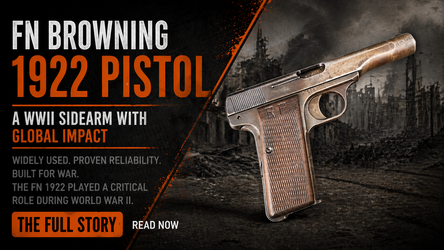
FN Browning 1922 Pistol: A WWII Sidearm with Global Impact
Posted by Quick Draw Gun on Apr 29th 2026
The FN Browning 1922 pistol, also known as the FN Model 1922, is one of the most historically significant handguns of World War II. Built on John Moses Browning’s proven designs, this compact semi-automatic pistol saw widespread use across Europe during one of the most pivotal conflicts in modern history.
While often overshadowed by more famous sidearms, the FN 1922 played a critical role for both military and police forces throughout WWII.
Origins of the FN Browning 1922
The FN Browning 1922 was developed by Fabrique Nationale (FN) of Belgium as an evolution of the earlier Browning Model 1910.
The key differences included:
- A longer barrel
- Extended slide
- Increased sight radius
These improvements were requested by military and police forces looking for a more practical service pistol.
Although John Moses Browning passed away in 1926, his design principles remained at the core of the FN 1922.
Design and Features
The FN 1922 is a blowback-operated, semi-automatic pistol chambered primarily in:
- .32 ACP (7.65mm Browning)
- .380 ACP (9mm Kurz)
Key features included:
- Single-action trigger
- Internal hammer design
- Manual safety
- Grip safety
The pistol’s simple and robust construction made it highly reliable and easy to maintain, even in harsh conditions.
Role of the FN 1922 During WWII
German Occupation and Production
When Germany occupied Belgium in 1940, the FN factory fell under German control. Production of the FN 1922 continued, but now for the German military.
The pistol was designated:
Pistole 626(b)
Large numbers were issued to:
- Wehrmacht officers
- Luftwaffe personnel
- Police units
These wartime-produced pistols often featured German markings and inspection stamps, making them highly collectible today.
Use Across Europe
The FN 1922 was not limited to German forces.
It was also used by:
- Belgian military and police
- Dutch forces
- Yugoslav military
- Various resistance groups
Its widespread adoption made it one of the more common sidearms in occupied Europe.
Why the FN 1922 Was Effective
The success of the FN 1922 during WWII came down to several factors:
Reliability
The blowback design ensured consistent function with minimal maintenance.
Compact Size
Its relatively small size made it easy to carry for officers and support personnel.
Ease of Production
The straightforward design allowed for continued production even under wartime conditions.
FN 1922 vs Other WWII Pistols
When compared to other WWII-era pistols, the FN 1922 occupied a unique niche.
Compared to the Walther P38
- The P38 was a full-power service pistol (9mm Luger)
- The FN 1922 was smaller and lighter, intended more for officers and police
Compared to the Luger P08
- The Luger was more complex and expensive to produce
- The FN 1922 was simpler and more practical for mass production
Compared to the Colt 1911
- The 1911 fired a much more powerful cartridge (.45 ACP)
- The FN 1922 prioritized portability over stopping power
Post-War Use and Legacy
After WWII, the FN 1922 continued to see service in various countries.
It remained popular for:
- Police forces
- Civilian ownership
- Export markets
Many surplus pistols made their way into the United States, where they became valued by collectors and enthusiasts.
Collectibility Today
The FN Browning 1922 is now a sought-after collector’s firearm, especially examples with:
- German WWII markings
- Matching serial numbers
- Original finish
Collectors often look for pistols marked with Waffenamt stamps, indicating German military acceptance during the war.
Why the FN 1922 Still Matters
The FN 1922 represents a key moment in firearms history:
- It bridges pre-war and wartime design
- It demonstrates the adaptability of Browning’s designs
- It reflects the realities of wartime production and use
While it may not have the fame of other WWII pistols, its widespread use and reliability make it an important piece of history.
Final Thoughts
The FN Browning 1922 is more than just a compact pistol—it is a symbol of wartime adaptation and engineering efficiency.
From its origins in Belgium to its use by German forces during WWII, the FN 1922 proved itself as a dependable and practical sidearm.
For collectors, historians, and firearms enthusiasts, it remains a fascinating example of how design and history intersect.
Explore Historic Firearms at Quick Draw Gun
At QuickDrawGun.com, we appreciate the history behind the firearms we carry. From modern defensive pistols to historically significant designs, we offer a wide selection for collectors and enthusiasts alike.