
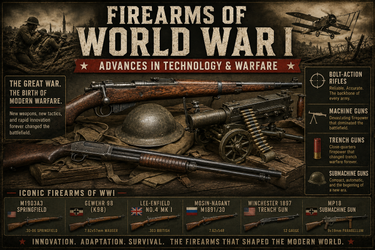
Firearms of World War I: How Innovation Changed Warfare Forever
Posted by Quick Draw Gun on Jul 7th 2026
When World War I erupted in 1914, most military leaders expected a short, decisive conflict fought with tactics that had changed little since the late 1800s. Instead, the world witnessed four years of brutal trench warfare where new technologies transformed the battlefield forever.
No area evolved faster than firearms. From bolt-action rifles and machine guns to the first submachine guns and combat shotguns, World War I became the proving ground for weapons that would shape military doctrine for decades.
Here's a look at the firearms that defined the Great War and the technological advances that changed modern warfare.
The End of Traditional Warfare
Before WWI, armies still relied heavily on mass infantry charges supported by cavalry and artillery. These tactics quickly became obsolete once rapid-fire rifles and machine guns entered widespread service.
The result was devastating.
Millions of soldiers found themselves locked in trench systems stretching hundreds of miles across Europe, where firepower—not maneuver—dominated the battlefield.
Firearms had officially entered the modern age.
The Bolt-Action Rifle Remained King
Although automatic weapons received much of the attention, the bolt-action rifle remained the primary weapon carried by nearly every soldier during World War I.
United States
Springfield M1903
The American Springfield M1903 chambered in .30-06 Springfield was one of the most accurate military rifles of its era. Based heavily on the Mauser 98 design, it featured excellent sights, a smooth action, and superb long-range capability.
Its precision also made it one of America's first true sniper platforms.
Germany
Gewehr 98
Germany entered the war carrying the legendary Gewehr 98.
Chambered in 7.92×57mm Mauser, the rifle introduced features still found in modern bolt-action rifles today:
- Controlled-round feed
- Large claw extractor
- Dual locking lugs
- Exceptional reliability
The Gewehr 98 became the foundation for countless sporting rifles and eventually evolved into the famous Karabiner 98k of WWII.
Britain
Short Magazine Lee-Enfield (SMLE)
Perhaps the fastest bolt-action rifle ever fielded, the SMLE Mk III gave British troops an incredible advantage.
Its:
- 10-round detachable magazine
- Extremely smooth bolt
- Short bolt throw
allowed trained riflemen to fire remarkably quickly.
British soldiers became famous for the "Mad Minute," during which skilled shooters could place 20 to 30 accurate rounds on target in just one minute.
France
Lebel Model 1886 & Berthier
French troops initially relied on the Lebel 1886, the world's first smokeless powder military rifle.
Later, many units transitioned to the lighter and more practical Berthier rifle, improving handling while maintaining battlefield effectiveness.
Russia
Mosin-Nagant M1891
Russia's Mosin-Nagant served throughout WWI and continued into WWII.
Simple, rugged, and chambered in the powerful 7.62×54R, it proved capable of surviving incredibly harsh battlefield conditions.
The Machine Gun Changes Everything
No firearm altered warfare more dramatically than the machine gun.
Defensive positions became nearly impossible to assault without enormous casualties.
Maxim Gun
Invented by Hiram Maxim, the Maxim became the world's first truly successful fully automatic machine gun.
Water-cooled and belt-fed, it could sustain devastating rates of fire for extended periods.
German MG08
Germany's MG08, based on the Maxim design, became one of the deadliest weapons of the war.
Entire infantry attacks could be halted by a handful of well-positioned machine gun crews.
British Vickers
The Vickers Machine Gun gained legendary status for reliability.
Some crews reportedly fired hundreds of thousands of rounds without catastrophic failure.
Its reputation for dependability carried well into World War II.
Trench Guns: America's Secret Weapon
One of the most feared firearms of WWI wasn't a rifle at all.
It was the Winchester Model 1897 Trench Gun.
Equipped with:
- Heat shield
- Bayonet lug
- Pump action
- 12-gauge firepower
the Model 1897 excelled during close-quarters trench assaults.
German forces protested its use, arguing it violated the laws of war—a claim rejected by the United States.
Today, the trench gun remains one of the most iconic combat shotguns ever produced.
The Birth of the Submachine Gun
As trench warfare intensified, soldiers needed compact firearms capable of delivering rapid fire in confined spaces.
Germany answered with the MP18.
MP18
Introduced in 1918, the MP18 became the world's first practical submachine gun.
Chambered in 9mm, it offered controllable automatic fire that proved devastating during trench raids.
The MP18 directly influenced virtually every submachine gun that followed.
Sniper Rifles Come of Age
Although sharpshooters existed before WWI, the conflict saw sniper tactics become a formal part of military operations.
Common sniper platforms included:
- Springfield M1903
- Gewehr 98
- Lee-Enfield
- Mosin-Nagant
Improved optics and camouflage transformed snipers into some of the battlefield's most effective soldiers.
New Ammunition Technology
World War I also accelerated ammunition development.
Advances included:
- Armor-piercing rounds
- Incendiary ammunition
- Tracer ammunition
- Improved smokeless powders
- More consistent bullet manufacturing
These innovations laid the groundwork for modern military ammunition.
Manufacturing Revolution
The war demanded unprecedented firearm production.
Millions of rifles rolled off factory lines across Europe and America.
Manufacturers perfected:
- Interchangeable parts
- Large-scale machining
- Heat treatment
- Standardized production
These manufacturing advances would later benefit civilian firearm production as well.
The Legacy of WWI Firearms
Many firearms introduced or refined during World War I continued serving for decades.
Examples include:
- Springfield M1903
- Lee-Enfield
- Mosin-Nagant
- Mauser rifles
- Winchester 1897
- Vickers Machine Gun
Lessons learned from the conflict also inspired future designs including:
- M1 Garand
- M14
- MP40
- Thompson Submachine Gun
- Browning Automatic Rifle (BAR)
The firearms of World War I marked the transition from 19th-century warfare to the modern battlefield.
Why Collectors Still Value WWI Firearms
Today, original World War I firearms remain highly sought after by collectors and military historians.
Collectors prize them for:
- Historical significance
- Original military markings
- Matching serial numbers
- Battlefield provenance
- Early manufacturing techniques
- Connection to one of history's most pivotal conflicts
Owning one is more than adding a firearm to a collection—it's preserving a tangible piece of world history.
Final Thoughts
World War I forever changed the way wars were fought. Innovations in bolt-action rifles, machine guns, trench shotguns, sniper rifles, and submachine guns reshaped military tactics and influenced nearly every firearm that followed.
From the dependable Springfield M1903 and Gewehr 98 to the fearsome Winchester Model 1897 Trench Gun and groundbreaking MP18, these firearms helped define an era of rapid technological advancement under unimaginable conditions.
At Quick Draw Gun, we appreciate the history behind these legendary firearms. Whether you're a collector, military historian, or simply passionate about classic firearms, understanding the weapons of World War I offers valuable insight into how modern firearm technology evolved.