
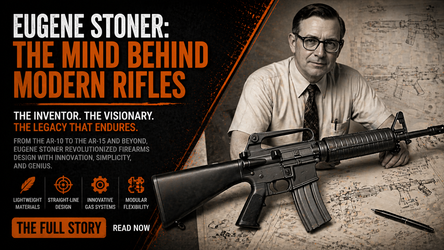
Eugene Stoner: The Man Who Changed Modern Firearms Forever
Posted by Quick Draw Gun on Apr 29th 2026
Few individuals have had as much impact on modern firearms design as Eugene Stoner. Best known as the creator of the AR-15 platform, Stoner’s work revolutionized rifle design and continues to influence military, law enforcement, and civilian firearms to this day.
His innovations were not just incremental improvements—they fundamentally changed how rifles are built, function, and perform.
Early Life and Background
Eugene Morrison Stoner was born in 1922 in Gosport, Indiana. Unlike many firearms designers of his era, Stoner did not come from a traditional gunsmithing background.
Instead, he developed his technical skills through:
- Aviation mechanics
- Marine Corps service during World War II
- Work in the aerospace industry
This aviation influence would later play a major role in his approach to firearm design.
Entry Into Firearms Design
After World War II, Stoner joined ArmaLite, a small but innovative firearms company.
At the time, ArmaLite was focused on developing lightweight, modern firearms using advanced materials.
Stoner quickly became the company’s chief engineer, where he began developing rifles that broke away from traditional steel-and-wood designs.
The Birth of the AR-10
Stoner’s first major breakthrough was the AR-10, developed in the 1950s.
The AR-10 introduced several revolutionary concepts:
- Use of aluminum receivers instead of steel
- Synthetic materials instead of wood
- Straight-line stock design to reduce recoil
- Direct gas system for operation
Although the AR-10 was ahead of its time, it did not initially achieve widespread military adoption.
However, it laid the foundation for something even bigger.
The AR-15 and Its Lasting Impact
The AR-10 design was scaled down into a lighter, smaller-caliber rifle known as the AR-15.
Chambered in 5.56×45mm, the AR-15 offered:
- Reduced recoil
- Lightweight construction
- High-capacity magazines
- Improved controllability
The design was eventually adopted by the U.S. military as the M16, becoming one of the most widely used rifles in the world.
What Made Stoner’s Designs Different
Eugene Stoner approached firearm design differently than his predecessors.
Lightweight Materials
Instead of relying on traditional steel and wood, Stoner used:
- Aluminum alloys
- Composite materials
This significantly reduced weight without sacrificing performance.
Straight-Line Design
The AR platform uses a straight-line stock configuration, which:
- Reduces muzzle rise
- Improves accuracy during rapid fire
This design is now standard in modern rifles.
Gas System Innovation
Stoner’s direct gas system (often called direct impingement) helped create:
- Fewer moving parts
- Smoother operation
- Reduced overall weight
This system remains a defining feature of the AR platform.
Later Work and Innovations
Eugene Stoner did not stop with the AR-15.
He went on to develop:
- Stoner 63 Weapons System, a modular platform adaptable into rifles, carbines, and machine guns
- Work with Knight’s Armament Company
- Contributions to modern military weapon systems
The Stoner 63, in particular, was ahead of its time with its modular design, something that has become increasingly popular in modern firearms.
Influence on Modern Firearms
Today, nearly every modern sporting rifle owes something to Stoner’s work.
His influence can be seen in:
- Modular rifle platforms
- Lightweight materials
- Ergonomic design improvements
- Modern gas-operated systems
The AR-15 platform alone has become one of the most popular rifle systems in the world.
Criticism and Controversy
As with any influential figure, Stoner’s designs have also been the subject of debate.
Early versions of the M16 faced reliability issues in Vietnam, largely due to:
- Ammunition changes
- Lack of proper maintenance training
However, these issues were later corrected, and the platform evolved into a highly reliable system.
Legacy of Eugene Stoner
Eugene Stoner passed away in 1997, but his legacy continues.
He is widely regarded as one of the most important firearms designers in history, alongside names like John Moses Browning.
His work transformed:
- Military rifle design
- Civilian sporting rifles
- The future of modular firearms
Why Eugene Stoner Still Matters Today
The impact of Eugene Stoner is impossible to overstate.
Modern rifles are:
- Lighter
- More modular
- More adaptable
Because of the principles he introduced decades ago.
Whether used for sport shooting, hunting, or professional applications, Stoner’s influence is present in countless firearms around the world.
Final Thoughts
Eugene Stoner was not just an inventor—he was a visionary who reimagined what a rifle could be.
From the AR-10 to the AR-15 and beyond, his designs have shaped the modern firearms landscape in ways that are still evolving today.
For anyone interested in firearms history, engineering, or modern rifle platforms, understanding Eugene Stoner is essential.
Explore Modern Rifles at Quick Draw Gun
At Quick Draw Gun, we carry a wide selection of modern sporting rifles inspired by Eugene Stoner’s groundbreaking designs.
Whether you are a collector, enthusiast, or first-time buyer, the AR platform remains one of the most versatile and proven systems available.