
Bolt-Action Rifles of WWII: The Workhorses of the Battlefield
Posted by Quick Draw Gun on Jul 7th 2026
World War II introduced tanks, aircraft, machine guns, and semi-automatic rifles on a massive scale, but the backbone of most infantry forces remained the bolt-action rifle. Reliable, accurate, rugged, and relatively simple to produce, bolt-action rifles served in every major theater of the war.
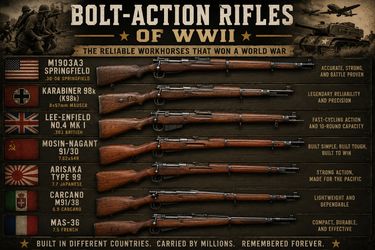
From the American M1903A3 Springfield to the German Karabiner 98k, these rifles became icons of military history.
Why Bolt-Action Rifles Still Dominated WWII
Although semi-automatic rifles were emerging, most nations still relied heavily on bolt-action designs because they were dependable, affordable to manufacture, and already widely issued. Soldiers could use them in mud, snow, jungle, desert, and urban combat with confidence.
They were not the fastest rifles on the battlefield, but they were proven tools.
M1903A3 Springfield
The M1903A3 Springfield was one of America's most respected bolt-action rifles. Chambered in .30-06 Springfield, it offered excellent accuracy, strong stopping power, and rugged dependability.
While the M1 Garand became America's primary service rifle, the 1903A3 continued to serve in training, guard duty, and combat roles. Its excellent sights and smooth action also made it a strong platform for marksmanship.
German Karabiner 98k
The Karabiner 98k, often called the K98k, was Germany's standard infantry rifle throughout WWII. Chambered in 8mm Mauser, it was a shortened and refined version of the Mauser 98 system.
Known for its strength, reliability, and accuracy, the K98k became one of the most recognized military rifles in history. It also served as the basis for many German sniper rifles when fitted with optics.
Lee-Enfield No. 4 Mk I
The British Lee-Enfield No. 4 Mk I was famous for its fast-cycling action and 10-round magazine. Chambered in .303 British, it gave British and Commonwealth troops a higher practical rate of fire than many competing bolt-action rifles.
Its rugged construction and smooth bolt made it especially effective in rapid-fire infantry use.
Mosin-Nagant 91/30
The Soviet Mosin-Nagant 91/30 was simple, tough, and produced in enormous numbers. Chambered in 7.62x54R, it served across the brutal Eastern Front in some of the harshest conditions of the war.
While not as refined as some Western designs, the Mosin-Nagant earned a reputation for durability and battlefield effectiveness.
Japanese Arisaka Type 99
Japan's Arisaka Type 99 was chambered in 7.7 Japanese and featured one of the strongest bolt actions of the war. Built for Imperial Japanese forces, it saw service throughout the Pacific.
Early examples were well-made, while late-war production rifles became increasingly simplified as Japan's resources declined.
Italian Carcano M91/38
The Carcano M91/38 served Italian forces during WWII. Chambered most commonly in 6.5 Carcano or 7.35 Carcano, it was lightweight and handy, though often considered less powerful than some of its contemporaries.
Despite mixed opinions, the Carcano remained an important part of Italy's wartime small arms history.
French MAS-36
The MAS-36 was France's modern bolt-action service rifle at the start of WWII. Chambered in 7.5 French, it was compact, durable, and simple. Although France fell early in the war, the MAS-36 continued to see use with French forces and postwar armies.
Why These Rifles Matter Today
WWII bolt-action rifles are more than old military surplus guns. They are historical artifacts that tell the story of the soldiers, nations, and battles that shaped the 20th century.
Collectors value them for:
- Military history
- Original markings
- Matching serial numbers
- Battlefield use
- Sniper variants
- Manufacturer codes
- Condition and originality
Final Thoughts
The bolt-action rifles of WWII may not have been the newest technology of the era, but they were among the most trusted weapons carried by soldiers around the world. The M1903A3 Springfield, K98k Mauser, Lee-Enfield, Mosin-Nagant, Arisaka, Carcano, and MAS-36 each played an important role in the conflict.
For collectors and history enthusiasts, these rifles remain some of the most fascinating firearms ever produced.