
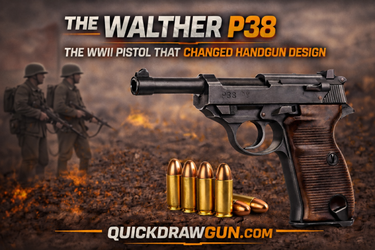
The Walther P38: The German Sidearm That Changed Handgun Design
Posted by Quick Draw Gun on Mar 13th 2026
During World War II, many innovations in firearms reshaped the battlefield. While rifles and machine guns often get the most attention, the development of modern military handguns also played an important role.
One of the most influential pistols of the war was the Walther P38, a 9mm semi-automatic handgun that introduced several groundbreaking features still used in modern pistols today.
Originally developed to replace the famous Luger P08, the Walther P38 became one of the most important German sidearms of WWII and helped influence handgun design for decades to come.
Why Germany Needed a New Service Pistol
Before the P38, Germany relied primarily on the Luger P08 as its standard military pistol.
The Luger was an accurate and well-respected handgun, but it had several drawbacks:
- Complex manufacturing
- Expensive production
- Sensitive to dirt and harsh battlefield conditions
- Difficult to produce in large wartime quantities
As Germany prepared for large-scale war in the late 1930s, the military needed a pistol that was simpler, cheaper, and faster to manufacture.
The answer came from Carl Walther GmbH, a German firearms manufacturer already known for innovative handgun designs.
Development of the Walther P38
Walther began designing a new service pistol in the mid-1930s, and after several prototypes and improvements, the Walther P38 was officially adopted by the German military in 1938.
The pistol was chambered in 9×19mm Parabellum, the same cartridge used in the Luger.
However, the P38 introduced several major innovations that would later become standard in modern handgun design.
Key Innovations of the Walther P38
The Walther P38 was revolutionary for several reasons.
Double-Action / Single-Action Trigger
One of the biggest innovations was the double-action/single-action trigger system.
This allowed the pistol to be carried safely with a round in the chamber and the hammer down.
The first trigger pull would both cock and fire the pistol, while subsequent shots operated in single-action mode.
Today, this system is still used in many pistols such as:
- Beretta 92
- SIG Sauer P226 & P229
- CZ-75 variants
Decocker Safety
The P38 also introduced one of the first decocker safety systems on a military handgun.
This allowed the shooter to safely lower the hammer on a loaded chamber without firing the pistol.
This feature dramatically improved safety for soldiers carrying the pistol in combat conditions.
Open Slide Design
Another distinctive feature of the Walther P38 was its open slide design, which exposed much of the barrel.
This design helped improve reliability by reducing the chance of jams or ejection failures, even in dirty battlefield environments.
The concept later influenced the famous Beretta 92 pistol, which shares a similar open-slide design.
Walther P38 Specifications
| Feature | Walther P38 |
|---|---|
| Manufacturer | Walther, Mauser, Spreewerk |
| Cartridge | 9×19mm Parabellum |
| Magazine Capacity | 8 rounds |
| Barrel Length | 4.9 inches |
| Action | Double-Action / Single-Action |
| Weight | ~34 oz |
Manufacturers of the Walther P38
As WWII intensified, demand for pistols increased dramatically. To meet wartime production needs, several factories manufactured the P38.
Primary WWII Manufacturers
Walther (ac code)
The original designer and primary manufacturer early in the war.
Mauser (byf code)
Mauser began producing the P38 as wartime demand increased.
Spreewerk (cyq code)
Spreewerk manufactured large numbers of P38 pistols later in the war, often with rougher wartime finishes.
Each factory marked their pistols with unique production codes, which collectors today use to identify their origin.
Production Numbers During WWII
Between 1939 and 1945, Germany produced roughly:
1.2 million Walther P38 pistols
These pistols were issued to:
- German Army officers
- Wehrmacht troops
- Luftwaffe personnel
- Waffen-SS units
The P38 quickly became one of the most widely used German sidearms of World War II.
The Walther P38 on the Battlefield
The Walther P38 gained a reputation as a reliable and effective military sidearm.
Compared to the Luger, it offered several advantages:
- Easier wartime manufacturing
- Improved reliability in harsh conditions
- Safer carry with a decocking system
- Simpler internal design
German officers, tank crews, and specialized units often carried the P38 as their primary sidearm.
The P38 After World War II
After WWII ended, the influence of the Walther P38 did not disappear.
Many captured P38 pistols were brought home by Allied soldiers as war trophies, making them highly collectible today.
The design also continued in production.
West Germany later produced an updated version known as the:
Walther P1
The P1 served in the West German military from the 1950s through the 1990s.
Collecting Walther P38 Pistols Today
Today, the Walther P38 remains one of the most collectible WWII pistols.
Collectors often look for:
- Matching serial numbers
- Factory codes (ac, byf, cyq)
- Original wartime finish
- Correct magazines and holsters
- Early production examples
Because of their historical importance and unique design, original WWII P38 pistols continue to be highly sought after.
The Legacy of the Walther P38
Few pistols have had the lasting influence of the Walther P38.
Its innovations helped shape modern handgun design, and many of its features are now considered standard across the firearms industry.
The P38 proved that a military sidearm could be:
- Reliable
- Safe to carry
- Efficient to manufacture
- Effective in combat
More than 80 years later, the Walther P38 remains one of the most important pistols ever developed.
Historic Firearms at Quick Draw Gun
At QuickDrawGun.com, we regularly feature collectible firearms that represent important moments in firearms history.
From WWII battle rifles to classic military pistols, these firearms help preserve the legacy of some of the most iconic weapons ever produced.