
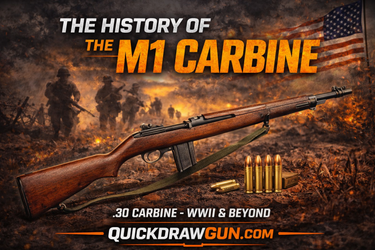
The History of the M1 Carbine: America’s Lightweight WWII Rifle
Posted by Quick Draw Gun on Mar 11th 2026
Few firearms from World War II are as recognizable as the M1 Carbine. Lightweight, reliable, and easy to handle, the M1 Carbine became one of the most widely issued American firearms of the war. Designed to provide soldiers with a compact and effective defensive weapon, the M1 Carbine eventually earned a place not only in military history but also in American hunting culture.
Today, collectors, shooters, and historians continue to appreciate the M1 Carbine for its innovative design and the critical role it played during World War II.
The Birth of the M1 Carbine
In the late 1930s, the U.S. military began searching for a firearm that would bridge the gap between the M1911 pistol and the M1 Garand rifle.
Many soldiers, including:
- paratroopers
- vehicle crews
- artillery operators
- support personnel
needed a firearm that was more effective than a pistol but lighter than a full battle rifle.
The result was the development of the U.S. Carbine, Caliber .30, M1, commonly known as the M1 Carbine.
In 1941, the rifle design created by David “Carbine” Williams and engineers at Winchester was selected by the U.S. Army.
The new rifle fired the .30 Carbine cartridge, which provided significantly more range and stopping power than a handgun while remaining lightweight and controllable.
M1 Carbine Production During World War II
Once the United States entered WWII after the attack on Pearl Harbor, the demand for firearms increased dramatically.
To meet the massive wartime production needs, the U.S. government contracted several companies to manufacture the M1 Carbine. Many of these companies had never produced firearms before, but American industry quickly adapted.
Over 6 million M1 Carbines were produced during World War II.
M1 Carbine Manufacturers
Several companies produced M1 Carbines during the war. Each manufacturer produced rifles under government contract and followed strict military specifications.
Major manufacturers included:
Winchester Repeating Arms
- Original developer of the M1 Carbine
- One of the primary manufacturers
- Produced rifles from 1942–1945
Inland Manufacturing (General Motors)
- Largest producer of M1 Carbines
- Manufactured over 2.6 million rifles
- Produced from 1942–1945
Underwood Elliott Fisher
- Known primarily as a typewriter company
- Produced carbines from 1942–1944
Rock-Ola Manufacturing
- Famous for producing jukeboxes
- Manufactured carbines between 1942–1944
Quality Hardware & Machine
-
Produced carbines between 1943–1944
National Postal Meter
-
Manufactured rifles from 1942–1944
Saginaw Steering Gear (General Motors)
-
Produced carbines between 1942–1944
IBM (International Business Machines)
-
Produced carbines between 1943–1944
Standard Products
-
Manufactured carbines from 1942–1944
Irwin-Pedersen
- Produced a very small number of rifles
- One of the rarest M1 Carbine manufacturers
Today, these manufacturers are highly sought after by collectors. Some examples are extremely rare and command significant collector value.
The M1 Carbine in World War II
The M1 Carbine quickly became one of the most widely used American firearms of WWII.
It was issued to:
- paratroopers
- tank crews
- officers
- radio operators
- support troops
- airborne units
Because of its compact design and 15-round detachable magazine, the rifle was easy to carry and quick to deploy in combat.
The M1 Carbine proved especially useful in environments where mobility was critical, including:
- airborne operations
- jungle warfare in the Pacific
- urban combat in Europe
The lightweight rifle allowed soldiers to move quickly while still carrying an effective firearm.
Development of the M2 Carbine
Late in the war, the M1 Carbine platform was further developed into the M2 Carbine, which featured select-fire capability.
This allowed the rifle to fire in both:
- semi-automatic
- fully automatic modes
The M2 Carbine used 30-round magazines, which increased its firepower significantly.
Although introduced near the end of WWII, the M2 Carbine would see more extensive use during the Korean War.
Post-War Surplus and Civilian Use
After World War II, millions of surplus M1 Carbines were placed into storage or distributed through government programs.
Many rifles were sold through the Civilian Marksmanship Program (CMP) and other surplus channels.
Because the M1 Carbine is:
- lightweight
- easy to shoot
- low recoil
It quickly became popular among civilian shooters.
M1 Carbines for Hunting
While originally designed as a military firearm, the M1 Carbine found a second life as a hunting rifle.
The .30 Carbine cartridge is well-suited for small to medium-sized game at moderate distances.
Hunters often used the rifle for:
- varmints
- whitetail deer
- coyotes
- small game
- pest control
In rural America, the M1 Carbine became a common ranch rifle due to its reliability and ease of use.
A Great Rifle for Youth and New Shooters
One of the biggest advantages of the M1 Carbine is its very mild recoil.
Compared to larger hunting rifles, the .30 Carbine cartridge produces significantly less recoil and muzzle blast.
Because of this, the rifle became popular for:
- youth shooters
- beginner shooters
- training new hunters
- The lightweight design and manageable recoil made it an ideal introduction to centerfire rifles.
Even today, many shooters consider the M1 Carbine one of the most enjoyable historic rifles to shoot.
The Legacy of the M1 Carbine
The M1 Carbine remains one of the most iconic American firearms ever produced.
With over 6 million rifles manufactured, it played a vital role in helping Allied forces achieve victory in World War II.
Its combination of:
- lightweight design
- reliability
- ease of use
made it a favorite among soldiers and civilians alike.
Today, the M1 Carbine continues to be appreciated by collectors, historians, and shooters who admire both its historical significance and practical design.
Historic Firearms at Quick Draw Gun
At QuickDrawGun.com, we regularly offer collectible and historic firearms that represent important chapters of American firearms history.
Whether you're interested in military surplus rifles, historic firearms, or classic hunting rifles, these firearms provide a connection to the past while still offering excellent performance today.
Explore our inventory to discover firearms that helped shape American history.