
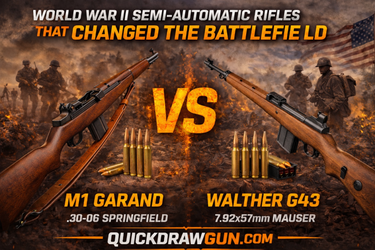
M1 Garand vs Walther G43: The Semi-Auto Rifles That Changed World War II
Posted by Quick Draw Gun on Mar 13th 2026
World War II saw some of the most important advancements in infantry weapons in history. Among those innovations were the widespread use of semi-automatic battle rifles, which dramatically increased the firepower available to frontline soldiers.
Two of the most notable semi-automatic rifles of the war were the American M1 Garand and the German Walther G43 (Gewehr 43). Both rifles represented a major step forward compared to traditional bolt-action rifles used by most armies at the time.
Although they were developed by opposing sides, both the M1 Garand and the Walther G43 helped shape the future of military rifle design.
The M1 Garand: America’s Revolutionary Battle Rifle
The M1 Garand, officially adopted by the U.S. Army in 1936, was the first semi-automatic rifle to be widely issued to an entire military force.
Designed by John C. Garand at Springfield Armory, the rifle fired the powerful .30-06 Springfield cartridge and used a gas-operated action that automatically cycled the bolt after each shot.
Key Features of the M1 Garand
- Semi-automatic gas-operated rifle
- Chambered in .30-06 Springfield
- 8-round en-bloc clip system
- Effective range over 500 yards
- Rugged battlefield reliability
The M1 Garand allowed American infantry to fire significantly faster than soldiers armed with traditional bolt-action rifles.
General George S. Patton famously described the Garand as:
“The greatest battle implement ever devised.”
During WWII, the Garand saw action across all major theaters including:
- Normandy and Western Europe
- North Africa
- Italy
- The Pacific Islands
The Walther G43: Germany’s Answer to the Garand
While the United States fielded the semi-automatic Garand early in the war, Germany initially relied heavily on the bolt-action Kar98k rifle.
However, German troops quickly realized the advantages American soldiers had with semi-automatic rifles.
In response, Germany developed the Gewehr 43 (G43), produced by Walther beginning in 1943.
The G43 was heavily influenced by earlier German semi-auto designs and incorporated lessons learned from the Soviet SVT-40 rifle.
Key Features of the Walther G43
- Semi-automatic gas-operated rifle
- Chambered in 7.92×57 Mauser (8mm Mauser)
- 10-round detachable magazine
- Scope mounting capability for sniper use
- Effective range similar to the Kar98k
The G43 offered German soldiers increased firepower and was often issued to designated marksmen and infantry units during the later stages of the war.
M1 Garand vs Walther G43: Key Differences
| Feature | M1 Garand | Walther G43 |
|---|---|---|
| Country | United States | Germany |
| Year Introduced | 1936 | 1943 |
| Cartridge | .30-06 Springfield | 8mm Mauser |
| Magazine | 8-round en-bloc clip | 10-round detachable magazine |
| Operation | Gas-operated | Gas-operated |
| Production Numbers | ~5.4 million | ~400,000 |
One of the biggest differences between the two rifles was production scale.
The United States produced millions of M1 Garands, making it the standard rifle for American infantry throughout the war.
Germany, facing industrial strain and Allied bombing campaigns, produced far fewer G43 rifles. Around 400,000 were manufactured.
Battlefield Impact
The M1 Garand gave American soldiers a major advantage in terms of rate of fire.
Where a bolt-action rifle required the shooter to manually cycle the bolt after every shot, the Garand allowed rapid follow-up shots with minimal effort.
German troops equipped with the G43 could also fire quickly, but the rifle arrived later in the war, limiting its overall battlefield impact.
Despite this, the G43 proved effective and became one of the most respected German rifles of WWII.
Sniper Variants
Both rifles were also adapted for sniper roles.
M1 Garand Sniper Models
- M1C
- M1D
These rifles were equipped with scopes and used by American snipers during WWII and the Korean War.
Walther G43 Sniper Rifles
The G43 was frequently issued with the ZF4 scope, creating an effective semi-automatic sniper platform.
Because of its detachable magazine and semi-automatic operation, the G43 could provide faster follow-up shots than traditional sniper rifles.
Reliability and Durability
The M1 Garand was widely regarded as more reliable under harsh battlefield conditions.
Its rugged design allowed it to perform well in environments ranging from the freezing conditions of Europe to the humid jungles of the Pacific.
The G43, while effective, sometimes suffered from durability issues due to wartime production shortcuts and material shortages in Germany.
Legacy of the M1 Garand and Walther G43
Both rifles helped influence future military firearms development.
The M1 Garand directly inspired later American rifles, including:
- M14
- M21 sniper rifle
The Walther G43 influenced later European battle rifle designs and demonstrated the benefits of semi-automatic rifles for infantry combat.
Today, both rifles are highly collectible and remain important pieces of WWII firearms history.
Collecting WWII Battle Rifles
Collectors continue to seek original examples of both the M1 Garand and Walther G43.
These rifles represent:
- Major technological advances in infantry weapons
- Important pieces of WWII military history
- Some of the most iconic firearms ever produced
Original rifles with matching parts, correct markings, and historical provenance can be extremely valuable.
Historic Firearms at Quick Draw Gun
At QuickDrawGun.com, we regularly offer collectible and historic firearms that represent key moments in firearms history.
From military surplus rifles to modern sporting firearms, these firearms help preserve the legacy of some of the most important weapons ever produced.